This first bill allows the state of California to regulate and oversee all 3D prints in the name of public safety.
in the name of public safety
In the name of gutting small manufacturing and the ability to repair your own devices. This has never had anything to do with safety, as they can’t even do the thing the bill demands. Fucking asinine
Next steps I’m sure. Then they ban you from printing anything that resembles a patented device, anything that looks like a medical device (can’t skip certification), and anything that looks like a toy (SAVE THE CHILDREN!).
“Uhoh, can’t 3d print a gun. Guess I’ll just go to Walmart.”
More like “Guess I’ll just print this file labeled ‘hyper realistic movie prop lazer blaster’.”
Or google zip gun. All you need to shoot 9mm is 9mm internal diameter pipe
Me when I walk 30 feet to the east and buy a gun under the table with no paperwork for less than the cost of a 3d printer
I doubt you can do that in California
Guess I’ll go to Nevada.
This guy gets it.
No, but if the laws are anything like Massachusetts, then you can buy an AR-15 out of the trunk of the car of a dude who was selling it on Facebook.
Completely legal resale so long as you both sign off on the ownership paperwork.
but if the laws are anything like Massachusetts
Californian here. They’re not. Lol. I mean you can do a private party sale and the guy is welcome to store the rifle in his trunk on his way to the meet, but all firearm sales or transfers have to be done at an FFL (basically a registered gun store) and require a 10 day waiting period, meaning you’d meet with the person at the store, do a shit ton of paperwork, pay a fee to the FFL and the DOJ, go home without the gun. Then come back 10 days (specifically 240 hours) later to meet up again, do some more paperwork, pay the person, and you’re now the proud owner of a gun that cost you 15-25% more and infinitely longer to acquire than if you lived 200 miles to the East.
Thankfully, making guns so much more expensive and tedious to acquire than damn near everywhere else in the country has rendered it physically impossible for criminals to steal guns or otherwise obtain them illegally. Now, if someone goes on a killing spree in a shopping mall, they may face legal repressions if the paperwork doesn’t come back clean.
Paperwork?
Similar to selling your car privately. There are some forms involved to recognize that you no longer own nor are responsible for the gun in question. It’s probably a little more strict and polished now (maybe not), but it wasn’t that long ago that you kept a copy in case the cops came knocking looking for the gun and a copy got filed away in a drawer somewhere for basically the same reason. I can’t remember if gun stores were in charge of the records for private sales (which wouldn’t make sense) or if they were filed with the town/state, but it was all physical paper in a drawer somewhere regardless. There wasn’t like a system actively tracking ownership - so long as both parties had a LTC, they were okay and third party sales could be done anywhere.
State by state for sure. Florida has no paperwork of any kind for guns unless its an NFA item, and thats federal paperwork.
MA is probably not a good example, because you also have to have an LTC, and the AR has to be legally owned in state on 8/1/26, and you have to register the transaction, and probably other restrictions I don’t remember off the top of me head.
True, but it’s the one that I know and up until around the early to mid 2000s, you could buy a shotgun in Wal Mart. They had a whole section dedicated to firearms.
Plus, the whole selling an AR out of the trunk of a car in the Wal Mart parking lot is something that a kid I went to school with actually did in Mass. There’s still plenty of regulation involved (and increasing by the sounds of it based on what you said), but at the time it basically boiled down to signing the paperwork signifying the change in ownership and resale of the firearm. The only time the state would’ve been made aware was if they requested to see the paperwork, AFAIK.
Besides, the vast majority of people 3d printing guns are people with an LTC anyway, and the most frequently printed things are furniture and accessories. 3d printed guns are still largely a novelty, despite how much they’ve improved over the years. Even the much feared gun that Luigi Mangione supposedly used was bought legally, and any 3d printed parts were merely aftermarket grips or the like. The only large scale use of them that I’m aware of is in Myanmar, where they’re using 3d printed guns to fight against a genocidal regime largely because they can get 3d printers and ammo, but no country is willing to support the resistance and so they can’t get any actual firearms. You’re much more likely to see a Garage Gun like the one used to kill Shinzo Abe, and those are completely legal by federal law - largely because it would be impossible to prevent somebody from just gluing a PVC pipe to a 2x4 and using a nail as a firing pin.
But firearms are so easy to obtain in so many states that it’s much easier to buy one than to build one from scratch (whether that’s buy one in the state or one with more lax laws nearby). There used to be a ban on gun stores within the city limits of Chicago, but Republicans got elected into office for like a decade and not only repealed that ban but also took the bite out of the gun laws, and now they claim that Chicago is proof that gun laws don’t work when the city used to have some of the lowest rates of gun violence in the country. When they’re not being bought right in the city/state, they’re being smuggled in from the next state over with little concern for punishment.
Jokes aside it’s to prevent having one that’s not registered
Not all legal firearms are registered anyway already. Not to mention it is completely legal to build your own gun in the US. So long as you aren’t building something NFA regulated (full auto, over .50 caliber, short barrel shotgun, silencer, etc.) and you are not distributing them to anyone, you are allowed to just build a gun. There are places online that sell “receiver blanks” with plans for how to finish them with very basic machining, and then you can buy all the rest of the parts off the shelf at any gun store without any registration at all because only the receivers are regulated even a little bit.
This has nothing to do with gun control. The entire concept of “ghost guns” has been a scare tactic to get enough public on-side to pass draconian surveillance and manufacturing control laws like this. The goal of this is to monitor “at-home manufacturing” (of anything, nothing to do with guns anymore than it has to do with warhammer compatible miniatures) and restrict the practice.
For reference of just how easy this is, most AR-15s that I’ve seen have been units built from individual parts, my own included. That’s kinda the AR-15’s whole schtick, is that it’s super modular and customizable, so much that a lotta people joke that it’s “LEGOs for adults.” It makes good sense, if company A makes a good upper, but Company B makes good triggers, so why not mix and match for the best of both worlds?
also the real gun companies are salivating over this, they dont want thier bottom line to be reduced if people are just making thier own.
Under the proposal, printers would have to evaluate STL files, CAD files, or other geometric code using a firearm blueprint detection algorithm and block files flagged as capable of producing a firearm or illegal firearm parts, including conversion devices.
California’s Department of Justice, or another relevant state agency, would have until January 1, 2028, to publish performance standards for detection algorithms and software control processes.
This is the problem when lawmakers write technical bills without speaking to technical people. They’re going to publish standards for evaluating if your gcode is a firearm or firearm part? THAT’S FUCKING IMPOSSIBLE
BANNED

It’s not even that, building a firearm…is legal…this shit going after printers makes no sense at all, it’s fucking legal to print firearm parts.
I bet they end up using a fucking llm
Yes that’s probably how you would do this. Get a bunch of data of gcode of 3d printed gun parts and not-gun parts, for different slicers and printers. Then train some transformer as a classifier. Based on how good object recognition is, i would say its possible that you would get reasonably good accuracy and precision. And because you are scanning for code the architecture will likely be similar to an llm.
Then five minutes later, someone figures out how to make a 3d printable gun that bypasses the gun detector on the 3d printer. It’s not like you’re printing a whole gun; you’re printing parts, most of which look nothing like a gun. How hard would it be to design an algorithm that takes a gun part cad file and then adds a bunch of extraneous pieces to it that can be easily removed? Just keep adding extra crap until the system no longer detects it as a gun part.
just rotate the piece at different angles on the plate, which would change the positions of vertexes and generate an unrecognizable set of printer head instructions. No extra pieces necessary; and even if there were, there’s no need for them to be printed attached to the main part.
Isleepinahammocks idea would probably work. But rotation and translation would not. Thats something you can easily take care of in your training data, by reusing the same training data in multiple random positions and random angles.
are you familiar with 3d printing? The print head’s instructions will be completely different if you rotate the model. Unrecognizably different.
Yes i know. But this is trivially easy to get into the training data. You just slice models in random orientations and build your training dataset that way so the algortihm will recognize gun parts in every direction.
Yes that would probably work. There could be some essential features of weapon parts that an algorithm might still be able to learn, and a printer could also keep track of previously printed parts for the classification. I think its unlikely that there are essential features of gun parts that are specific to gun parts so there would probably be a lot of false positives.
Yeah I’m thinking of an automated version of greebling. Except you design the extraneous bits so that they’re only attached to the intended print like print supports - something in a non-critical location, easily torn away.
I think a problem might be that the “easily broken away” might be a feature that an algorithm might be able to learn.
Fun time to introduce/remind people of the Gell-Mann Amnesia Effect: The phenomenon of a person trusting newspapers for topics which that person is not knowledgeable about, despite recognizing the newspaper as being extremely inaccurate on certain topics which that person is knowledgeable about.
Same thing goes for laws and lawmakers. It’s almost as if selecting our “leaders” from a narrow band of society who, for the most part, don’t know shit about anything, does not lead to enlightened laws.
Lol I was just talking to my wife about that yesterday and how it’s exactly like AI.
If you read something in the newspaper about your job, you’re like “these fucking idiots got this all backwards.” If you see AI output of an attempt at your job, it’s the same thing.
But if you read an article about someone else’s job, you think “that makes sense.” Same about seeing AI trying to do someone else’s job.
In most cases, absolutely. There are a few jobs I can see an LLM performing as well or better. Though, then those people would be roaming the streets and do you really want your insurance claim denied while you’re out walking your dog or someone yelling about paradigm shifts to align synergies when you’re just having a nice day at the park?
Cosplayers are going to be pissed.
That’s a whole section on OnlyFans
The controller in my printer that was manufactured at mininum cost can’t “analyze a part using an algorithm”. Do they think it has any decent computational power?
That’s the point. This is just a foot in the door to block your access to print things that might be trademarked copyrighted or affiliated with your corporate overlords.
And a foot in the door to start blocking your right to repair your own things.
Guaranteed.
Yes they have no idea what they are asking. Stl is just gcode how do you look for a gun out of coordinates.
Kinda, render a few images from the gcode, use a CV algorithm to identify the object.
On device it’ll be slow or expensive.
Define gun is a lot harder then you think. For example

or

I know, but they want a solution implemented, that’s a solution.
Ah yes. Another passive asshole that codes this type of thing and goes home without even batting an eye because I got mine before someone else did.
Big assumptions
Its just either completly ineffective, or effectively bans 3d printing. Then you are going to run into enforcement, and legal challenges. Oh and even if all that is done guns will still be present at a ratio above 1:1 in the states.
Anyone who has a highschool level of metal shop can also make a firearm, 3d printing is not even well suited for the task. Just look at Japan, one of if not the most restricted nation for firearms, and someone shot a leader with a homemade firearm.
Your faith in this mystery algorithm is stronger than mine. Here’s a diagram of the parts in an AR-15:
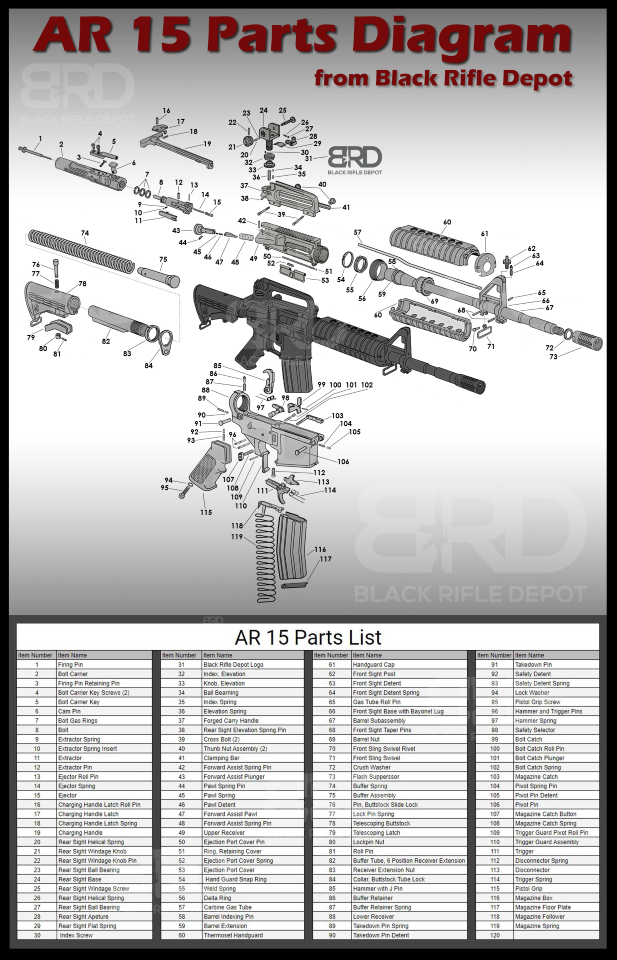
So we need an algorithm that renders the gcode I’m printing, then compares it to… something?
Look, I was just saying, it could be done, train it on current real and 3d printable gun parts and there, you did your best to create algorithmic gun filtering. I wasn’t saying that it would be good or accurate.
The algos don’t need to deny any or every part of a gun, but the most critical part must not be printable and it’ll already be effective.
I’m neither very experienced with firearms nor printing, maybe such a thing doesn’t exist for a gun, but I suspect there’s a few very important pieces that need to be printed a certain way or the firearm falls apart or is at least a lot less useful.
All that said, I’m generally against such limiting mechanism in any printer or compiler. Try close sourcing all compilers so they can’t create malware? Forget it.
I’m neither very experienced with firearms nor printing
Unfortunately that’s the crux of the issue. The people who have written and signed this bill aren’t either - and they weren’t as big of a person as you to recognize that.
At the end of the day, 3D printing gcode is telling your printer to spit out a shape. And you simply cannot ban shapes. Am I printing a firing pin or a part for my shoe rack? There’s no way to tell. Any politician that’s telling you there is is either ignorant or lying to you.
Worse still, gcode is literally just telling a machine which motors to move and how much. You need something that can interpret those instructions (thousands of lines of code even for pretty simple prints) correctly and “draw” the shapes it is making. There are a lot of printers out there that do not have the hardware on board to do this.
And that is all ignoring the absurdity of recognizing shapes as “gun parts”… The hardware hurdles pale in comparison to the software ones.
You’re gonna hate this, but… AI can literally do it, and for the large models it’s terrifying how accurate they are. You will argue that your little ESP32 powered reprap or klipper or whatever printer can’t handle it, to which regulators will go ok then, either the printer has to call out to a service with an http request to upload the gcode every time it wants to print anything, or your slicer has to do it (and we dont care that it’s open source, it’s illegal to operate if it doesnt make the call and you’re getting fines or jail time if you get caught).
This is what AI was built for 😟
EDIT:
In case it isn’t abundantly clear, I am not in favor of what I just described. I know that it is possible though and know how to architect exactly these mechanisms. If I can build them, so can they. (I won’t, of course, that goes against everything I stand for).
Even AI can’t do this. It is an impossibility. AI might be able to make the shape, but it will NEVER be able to interpret the intent of that shape. It will never know if a cylinder is meant for a gun or for a rolling pin. It will never know if I’m making a trigger for a gun or a replacement trigger for my hot glue gun.
Those cheap printers that don’t have onboard hardware to do this also generally don’t have any networking either. You’re lucky if you can get them to connect to a computer with USB - most of the print jobs exclusively get sent via a physical SD card.
The slicer is in a better position to do this draconian business, but they aren’t aiming this bill (from what I have found) at slicers at all (probably because they are all open source and, unless the law gets passed world-wide, they would just get forked and hosted by someone else in a place where they are still legal to be “dumb”). They are aiming at hardware. It is effectively a complete ban on cheap 3d printers, and turns the models “legal” to sell to a white-list style of control. The manufacturers that play ball get to continue business in the state, others do not.
All of this to stop a very tiny and difficult avenue for someone to get a gun, when there are much easier and more reliable options available and being used orders of magnitude more often. This has nothing to do with gun control, or guns. This is absolutely a play against 3d printing, at home manufacturing, and right to repair in general. The end goal is DMCA on 3d printing.
AI cannot be made to recognize whether a piece of gcode is intended to produce a piece of plastic that is intended to be used as part of a gun. It would need to simulate the machine that that gcode is made to run on, and then simulate the gcode running on that machine, and then analyze the simulated output of that simulated 3D print.
At best, it can arbitrarily decide to decline print jobs. Which is of course the whole point, because anyone with a printer would need to bypass this filter, and bypassing this filter would be against the law.
And you simply cannot ban shapes.
They have banned numbers, I mean hell go around shouting 13-12 and see how long it takes for you to get a fine/get arrested. I wouldn’t say that banning shapes is far off
3D printed gun designs these days don’t even use plastic for most of the critical parts. The goal is to print a frame, which you can then assemble into a full gun using durable off-the-shelf parts that are available from any hardware store. No need to 3D print a bolt (and deal with all of the manufacturing issues that entails) when you can just buy a bolt for 5¢ at any hardware store. Especially when that bolt will be more precise and durable than the plastic bolt you would have printed.
It’s the old carpentry idea that if you can’t get precision by hand, you can borrow it from something else. Need to cut a bunch of identical boards, with precision in 64ths of an inch? A #8-32 bolt will have 32 threads per inch. So a half turn on the bolt will advance or retract the bolt 1/64 inches, accurate down to whatever the bolt manufacturer’s clearance is. Probably a few thousands of an inch. Build a jig to hold your boards at the saw, and thread a bolt into the jig to act as the board stop. Now you can turn the bolt to adjust your clearance as needed, and you’ll be accurate down to 1/64 by only making half turns each time.
And 3D printed guns use the same concept. You don’t print a plastic barrel that will explode after two or three shots, you just leave a void for a store-bought pipe to fit into the frame. The pipe will be more durable and more precise than anything you could feasibly print. You don’t need to 3D print a firing pin that will blunt/shatter/jam after a few uses, when you can just use a steel nail that will have better durability and avoid jamming. And all of the parts you need can be bought at a hardware store without raising any suspicions. That’s part of what makes this so dumb. They’re not just requiring printers to scan for potential gun parts. They would require printers to scan for anything that could potentially hold or manipulate gun parts. And that is a much broader spectrum than simply scanning for the shapes of the parts directly.
They would require printers to scan for anything that could potentially hold or manipulate gun parts.
It’s worth explicitly noting that this effectively bans 3D printing entirely. The whole point of this law is to be able to charge owners of 3D printers with a crime. Real useful if they find out some anti-zionist protestor has a 3d printer in their garage. Can’t get ya on the free speech thing, but they can get you on the owning a non-compliant 3d printer thing.
For the rightoids out there, replace anti-zionist protest with anti-abortion protest. Or any other speech the government doesn’t like. This exists for the sole purpose of punishing innocent people.
you just leave a void for a store-bought pipe
So you’re saying the answer is to scan for voids! Thanks for your technical input
- your congressman, probably
That makes a lot of sense. If the print just holds the critical parts, forget it.
Printer: “not a hot dog”
Theres countless gcode use in the world, much of it is offline
Doesn’t matter. Has nothing to do with online.
You can run OpenCV on an RPi, it’s just super slow, and you could probably use a cheap GPU chip to do it faster. You store the pretrained model on the device.
You may even get away with an asic designed for the model, though with that one I’m talking out my ass.
That would makes printers more expensive and my guess is that they’ll prefer to force online connectivity
100%
Supporters say the measure tackles the problem before a downloadable file becomes an untraceable weapon. Everytown for Gun Safety says recoveries of 3D-printed crime guns across 20 cities have risen nearly 1,000% over the past five years, and argues that cheaper, more capable printers are already being used in illegal ghost gun operations.
Ooooh, that’s two large red flags for me (disregarding the litany of red flags the concept in general has). Every town being involved makes me question the data on its face, given the number of times I saw gang violence near a school out of school hours listed as a school shooting in their database, as does a large percentage increase with no hard numbers. If they recovered 1 gun last year and 11 this year, that’s a 1000% increase, but the percentage sounds so much worse than the real number.
Good luck. Tough to pick a more DIY-oriented bunch of hobbyists who would rather build their own hardware and compile their own software over allowing their printer to narc on them to the government.
RepRap 2: Countersurveillance Boogaloo, launching soon.
I am feeling bad for all the people that bought Bambu.
They’ve been obviously shitty and evil for a long time to anybody who cared to do even 5 seconds of research.
Truth. Unfortunately, so many people don’t do 5 seconds of research unless you count “I’ve seen basically every youtuber that 3d prints talking about how awesome this one is” as research.
I wish more people would see that a company being a sponsor everywhere or a product being advertised A LOT is a huge red flag and probably not where you should spend your money. I’m basically at the point that I don’t trust anything I see ads for at all - oh, you are wasting a ton of money on advertising? Your product is either markedly worse than the competition who isn’t wasting that money, or you have the same product and are way more expensive. Either way, that’s bad.
Us digital hippies just believe in free data and world peace, man.
Everytown for Gun Safety says recoveries of 3D-printed crime guns across 20 cities have risen nearly 1,000% over the past five years,
So… They found a total of ten 3d printed guns in the last 5 years?
325 are 3D out of 350,000 guns found in CA in connection to a crime in 2024, according to random assholes on reddit.
This is a pretty dumb thing to pass legislation on considering it’s still VERY easy to buy a gun even in CA, another method of getting a gun isn’t making it easier in any real sense.
Now to be totally fair, 325 is 325 more than 0, which would be the ideal number of 3d printed guns used in crime… But also, how many of those 3d printed gun users had access to a different gun and simply opted for the 3d printed one? I get the feeling it was somewhere around 325 of them
This is all ignoring the fact that I’m using a very liberal definition of the phrase “3d printed gun.” I doubt anyone is using Songbirds for armed robberies lmao
3d printing isnt shit except for ease of use. I can make a 12 gage slam fire shotgun in a couple hours with maybe $100 on a home depot or Lowes gift card. As a machinist and welder, I can make a whole lot more than that.
On the one hand, its moronic to think that limiting 3D printing will in any way affect ease of access to firearms. On the other hand, literally anything making it harder for people to kill or harm each other is probably for the best in the long run.
A comedian I watched a while back had a bit about if the government really wanted to stop gun violence, they’d put a massive tax on ready made ammunition. You really gotta hate a bitch to spend $5k on a bullet to kill them. Obviously this doesnt take into account making your own ammo, but the point stands.
Add to that the fact that some gun parts are not printable and have to be made out of metal. Printing an entire firearm on a $500 3D printer is possible but that gun will be good enough for 1 bullet, and probably will hurt shooter at that.
Also, if inmates can make a handgun out of whatever they have access at prison - 3d printing is the afterthought. Some parts can be bought in a department store, the others can be ordered online as a replacement parts. If someone really wants to make a gun themselves, 3D printing ban wont stop them.
and to be clear to naive: you can’t actually 3D print a gun. You can make parts that can be smithed together with metal parts to make a working gun. There are some fully plastic designs, but no way would I shoot those twice.
with metal parts to make a working gun.
That’s always convention “forgotten” in all these breathless “think of the children” arguments.
You can’t fully 3-d print a working gun that isn’t as dangerous to the user as it is to the target.
Percentages without a baseline are useless.
You can find more magnet fishing.
Why use AI generated bullshit images like this techspot…

Sad to see AI, but honestly that image made me laugh, because it seems to come straight from the mind of the author of this bill.
Hah true, it is sufficiently ridiculous and stupid.
Is it AI generated though? The quality looks pretty good to me

The text is fine, but thats not a printer ive ever seen, i dont think its a real product, looks like a promotional render for some kind of small form factor printer with a built in dry chamber. Cool idea, but its not a real product, or its incredibly low volume.
Edit: also the “gun” is bigger than the print bed, which cant happen. And the gun is huge, way bigger than actual gun unless that printer is tiny tiny. It might be a 3d render but 100% not done by someone who understands how any of this tech works. AI would be a strong candidate for all the mistakes
, i dont think its a real product,
Cubify 3D

only 140mm buildplate, what? is this a gun for ants?!

I posted above, but it is a real product:
3D Systems Cube 2 3D Printer:
Neat, if i wasnt trying to avoid bed slingers might have picked one up
That appears to be the 3D Systems Cube 2 3D Printer:
I would love to see a politician try to fire a gun printed like that. Genuinely, it would be fun to see it explode in their hands
- Buy a kit.
- Buy a mechanical kit and an electronics package.
- Build from scratch
- Buy out of state
- Buy an open source machine and flash the firmware
- Buy your fucking gun in an alley (way easier, and maybe cheaper.)
- Design and distribute stls that have parts that may be interpreted by whatever brain dead software is going to watch out for files, and print in two batches, say, something that may look like a lower, and then an upper, for a a nerf gun, for example, to glut the system.
The list goes on…
- Uncheck the “I am in California checkbox”
Sprues. An extra few grams of easily removable plastic and all of a sudden it can’t tell what it is.
Proposal: All elected officials must install Corruption Blocking Software that scans all their communications, financial records and assets, and uses advanced Corruption Pattern Matching Algorithms to determine if they might be taking bribes from industry lobbyists, pumping up their own investments, or secretly serving special interest groups, or if they’re just general nutjobs.
Honestly though… What’s the process for a regular idiot to try and suggest or propose new bills? I think I’d like to actually propose such a bill
That’s what “representative government” is all about. I’ve never tried to do this but theoretically you could write to your representative or senator and try to impress them with your idea. You’d probably get more traction by starting local with a city or town ordinance, or by creating a campaign on social media and in person - rally an impressive number of people to stand around city hall with signs requesting/demanding this kind of action, get noticed on news media, and build it into a credible movement. In many states citizens who collect enough signatures can place proposed legislation on ballots during regular elections.
Why stop at elected officials any company has to do this. If they can infringe our rights why not make sure everyone has their rights taken away.
Can’t regulate the parts as they are used in many many many devices. So as far as I’m concerned this is worthless. I can build a fucking 3d printer from an old VCR and a hot glue gun.
my interest is who is PAYING to fund the bill, i wouldnt be surprised if its gun companies or palantir.
You can, but 90% 3D printer buyers can’t, and that’s a good enough amount of people to spy on.
90%?
More like 99.999%
Including op.
There’s a difference between building a pile of crap and actually building something that works effectively. It’s a difficult hardware and software problem.
https://www.reprap.org/wiki/RepRap
The work has all been done long time ago.
The designs and software are all open source at this point.
exactly but that’s also good fuel to defeat the bill.
It’s also pretty much a technical impossibility if you know anything about 3D printers.
3D printers can’t read CAD. They aren’t fed STLs or any other kind of 3D model. They’re fed G-Code, which contains no geometrical details. It’s a list of instructions saying “turn these 4 motors this speed this for this amount of time while heating that part to this temperature and turning this other motor this speed, then heat this part while tunlrning that motor that fast…” with hundreds or thousands of instructions, and then new instructions for the next layer.
In order to print a model, you first have to run it through a program called a slicer that generates that G-code by slicing it into layers with instructions for how to move, heat and cool the nozzle, build plate, and chamber, feed the filament, etc.
The printers just follow those instructions with minimal on-board processing and zero information regarding the final model’s structure.
to comply, vendors would need to require printers sold in california to be locked (presumably by encryption) to a proprietary slicer with ai vision that could try to determine if the thing being printed looked like a gun. Maybe if there was a bullet sized barrel and access around the striker area.
Makerbot more or less did this. It was a pain in the ass to use a non-makerbot-desktop slicer with a 2/2x series.
But that actually wouldn’t meet the law. The law requires the printer to do the check.
The software becomes part of the printer. They are linked in a way that one cannot operate without the other.
I didn’t say the law was well written, I find the the most likely way to comply.
I wouldn’t be that hard to read the g-code and reconstruct the model programatically checking for bores and firing pin access, feed that data into a model with some RAG about internal gun dimensions, but the printers are generally too underpowered to do such a calculation.
it’s all a fools errand really, guns can be made out of a handfull of hardware store parts and a drill.
Those instructions can be translated into the final product. It isn’t hard when you know what each instruction produces…
Right, but it’s not something the printer does at all right now, I assume. Someone gives me Russian text to retype, I retype the letters, but I don’t speak Russian so I can’t be meaningfully asked to specifically not retype anything about highway design.
True but if you’re an organization tasked with spying of what ppl to make sure they aren’t innovating, or whatever, it isn’t hard to setup, it being in gcode isn’t a big hurdle here.
It’s pretty hard when you have to also account for extra printing to conceal the item. You can render a result, but if it just looks like a box with convenient breakaway pieces that snap to leave behind just the part, you’ll need some more complex work than simple pattern matching. And even then each piece of a gun isn’t a really a unique shape only used for firearms.
Assuming there is extra printing. That wastes resources and your iterative designs are also captured in sequence, which reveals the direction of your efforts.
Speaking as someone that knows basically nothing about 3d printing (though has done similar with CNC), do you think it’d be possible to reverse-engineer the code in some way? I’m thinking something like a simulated 3d printer 🤷♀️
You can, sure. but then you have a new file that is entirely distinct from the original model (as far as computer hashing is concerned). So you have to do several steps to legally comply with this:
-
Receive gcode file
-
use costly ai to convert the gcode to a 3d model.
-
use costly ai to try to figure out what the 3d model is.
-
do all of this either via a remote connection, or on a processor weaker than the median game console from the 1990s.
-
repeat for every single attempted print, which can be several dozen per completed product depending on how annoying the calibration was that day
So if you’re a 3d printing business you now have to have your own data center basically dedicated to the tens of millions of potential prints you’re going to receive, because it’s near impossible to fingerprint g-code as it’s dynamically generated from each different CAD software differently based on thousands of settings.
Essentially any 3d printer manufacturer is going to just say “not for use in california” instead of paying hundreds of millions of dollars a year to try to comply with this.
I don’t think you would have to use AI to convert gcode into a 3d model. The way I would approach it is basically run the gcode and take all the 3-D coordinates you get for where to print, then maybe run it through a filter or some such to extract just the outermost wall passes for each layer. Stack those up, do some sort of automated linking to create your triangles, and ship it off to the recognition AI.
it’s possible you could run that on a printer processor but unlikely.
-
there are many open sourced software applications than can produce G-Code for any printer. All of it can be done offline.
But the most popular brand right now forces server interaction.
Only if you want to use cloud printing. I print on my A1 using Orca all the time.
Jokes on you, my 3D printer is offline
Shit, same. Mine is basically a custom built Ender3 with open source firmware. I could (theoretically anyway) write my own firmware for it and ignore the law.
This is America, wouldn’t it be easier just to buy a gun? I get that 3D printers can make ghost guns that aren’t traceable but how many crimes have occurred where that is the murder weapon?
One CEO. More important than every dead schoolchild.
They asked about crimes.
Agreed. Every time I’ve looked into printing one I look at the process and just buy it. All the ghost guns I’ve made were from hollowed-out 80% lowers. And one time a hardware store slamfire shotgun.
I fully support one’s right to print a gat, but it sure ain’t for me.
Thats the neat part: they can make weapons the same way I can theoretically make a bomb from enriched uranium in my backyard.
Not as much as you think. The thing is even in countries with strict gun laws 3D printed firearms are a negligible part of firearm crime.
This isn’t to say that they don’t exist. I saw images of criminal gun factories in Australia (which have been around well before 3D printing) that had integrated 3D printing into their stuff, but they still do a lot of metal work, too.
I might print some guns purely out of spite.
In Minecraft.
Given they’ve postponed the standards until 2028, I am skeptical our legislators will be able to develop a viable benchmark. And then I don’t imagine it’s possible to enforce it.
This is likely to die in court.
They’ll ask chatgpt to generate it. It doesn’t need to be viable, it just needs to be impossible for manufacturers to comply with
I don’t think California intends to act in bad faith and try to kill the 3D printer industry (or community). I think this is due to misconceptions similar to the notion that one can create encryption with a backdoor that only the good guys can use. It just doesn’t math.
And that’s exactly what is going to kill the law in the courts, much the way that they’ve upheld strong encryption and Section 230 of the Communications Decency Act of 1996. Allowing the law to come into effect will cause too much damage to industry and the economy.
Granted I can’t be absolutely certain of that. We’ve had a lot of incompetent (or corrupt) judges get confirmed in recent decades, so really anything can happen. But the thing they don’t want is what happened after they tried to criminalize printed gun designs in the first place, and see the already-robust 3D printing underground get another growth boost.
It’ll be enforced just like child porn laws are. If you have enough money or political power (same thing really) then you won’t ever see a cop.
But us regular citizens will get fucked. Par for the course for a powerful, authoritarian government.