Explanation: Not nearly as damning as it first appears! It’s a chapter in a reflection about Roman history by Machiavelli, wherein Machiavelli notes that men attempting to avenge wrongs done to women are often the seed of larger conflicts, and so such quarrels should be treated seriously by the powers that be, not dismissed as private squabbles.
I’ve heard that, though I’m partial, personally, to the idea that The Prince is sincere in its realpolitik, but outlining in part how autocracies must be brutal simply to remain operational, with occasional reference to the civic virtues of republics by contrast.


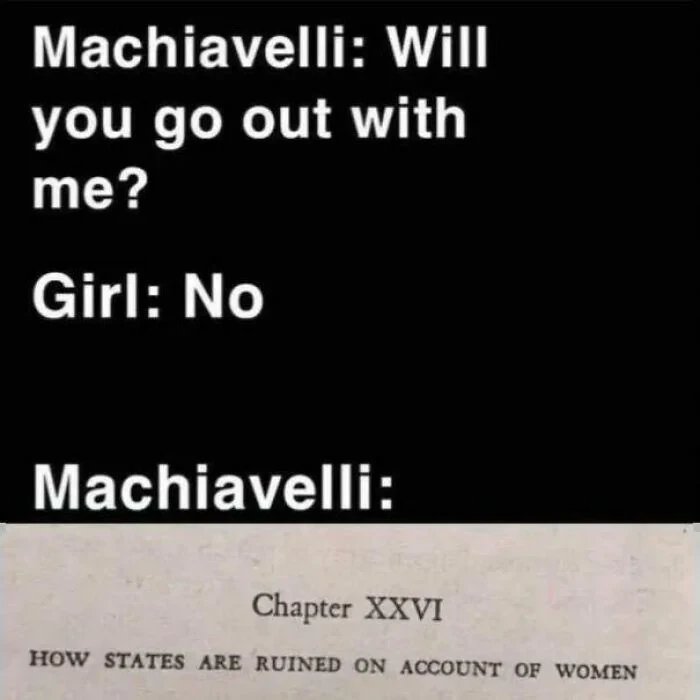
Explanation: Not nearly as damning as it first appears! It’s a chapter in a reflection about Roman history by Machiavelli, wherein Machiavelli notes that men attempting to avenge wrongs done to women are often the seed of larger conflicts, and so such quarrels should be treated seriously by the powers that be, not dismissed as private squabbles.
Still, what a title to open a chapter with!
There’s a theory that Machiavelli, being an ardent republican, wrote “the prince” to deliberately give terrible advice.
I’ve heard that, though I’m partial, personally, to the idea that The Prince is sincere in its realpolitik, but outlining in part how autocracies must be brutal simply to remain operational, with occasional reference to the civic virtues of republics by contrast.
But this is from his Discourses on Livy, I think.