

8·
21 hours agoOn the Chomsky business: Here’s two principled “libertarian socialists” having a discussion about how Venezuela isn’t real socialism.

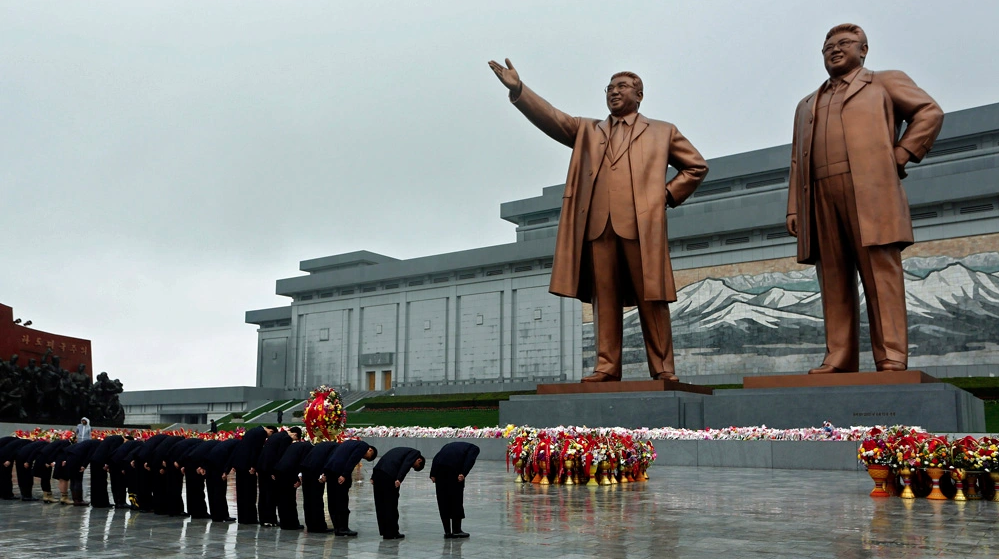
Kimilsungist-Kimjongilist.
On the Chomsky business: Here’s two principled “libertarian socialists” having a discussion about how Venezuela isn’t real socialism.
Mental impairment for physical reasons certainly exists, and there can be little doubt that some (at least) of the unfortunate persons who suffer from it hold absurd views on politics and many other things. But in general, I am not convinced that defects of the physical complex from which arises cognition – which complex we call, without really understanding it, the “brain” – are as common or as all-determining as most persons make out. Such people, having a smattering of what they think is Science, apply it crudely and mechanically, and believe that in reducing everything to a second-hand formula they have realized materialism; when in in their failure to recognize a concept as anything but a withered husk, a conclusion without the living sap of argument or struggle, they merely reproduce in themselves the immediate substantial world of belief. Thus, in a kind of miscarriage of Spirit, they give birth, not again to the living, multifarious world around them, but to a kind of stillborn and distorted image of the same; and their attribution of all opposition to what their stillborn conception of Science considers the most fundamental defect betrays only the poverty of their own conception.
How often have we met persons who, though given every advantage of culture, have yet failed to realize a full and living conception of the world; and conversely, have we not met persons who, though lacking in all the usual advantages toward knowledge, have yet realized in themselves the world as becoming! When the new world is born from the old, and further, its Notion has born fruit in the whole concrete richness of life, its essence is easy to grasp; when the old still exists, externally the same as ever but with the old meaning lost or changing, to grasp the essence is difficult, since it seems, the most real thing, to be unreal, fleeting, and with no genuine relation to substantial life. Who grasps it must do so in struggle, heroic and human, in concrete time; which is to say, such a one must be at the apex of the embodied struggle; and here we find the full essence of what is commonly termed “environment.”
(Apologies for the language. I was trying to crack Hegel last night).
The critique is that classical Marxism-Leninism treats humanity as object, not as subject. That is, there is in humanity an interior principle from which the social movement ultimately derives; this principle, described as “independence” or “Chajusong” is socially-created, and while conditioned by material forces, is not wholly reducible to them. Thus man is the subject of history, in that history is created – originated – by the masses; Marxism-Leninism fails to recognize this, and instead treats human progress solely as the result or “object” of external economic and social forces. In other words, Marxism-Leninism mistakes the conditions of the thing for the thing itself.
The creators of Marxism set as their main task overcoming the idealistic and metaphysical view of social history which served to justify the reactionary exploiting system and applying the materialistic and dialectical principles to the field of social history; they clarified that society, like nature, exists objectively and it changes and develops according according to the general law governing the material world. They however failed to elucidate the essential differences between the movement of nature and social movement and the law inherent in the socio-historical movement. The new era implies that the most important requirement for making the view of social history of the working class perfect, is to clarify the law peculiar to the social-historical movement whose motive force is the working masses. This historic task was fulfilled with credit by the Juche philosophy.
The Juche philosophy, by applying to social history the philosophical principle that man is the master of everything and decides everything, gave a fresh light to the principle that the masses are the motive force of history, and the socio-historical movement is an independent, creative, and conscious movement of the masses.
– Kim Jong-Il, On Some Problems of the Ideological Foundation of Socialism, 1990
Though the Juche Idea does not replace Marxism-Leninism, it is nevertheless distinct:
In explaining and propagating the Juche philosophy we do not need to convince people that the Juche philosophy is a new development of Marxist materialist dialectics. It is true that our Party has not taken a dogmatic approach to Marxist materialistic dialectics but analyzed it from the point of view of Juche and has given new explanations to a number of problems. However, some development of materialism and dialectics dose not constitute the basic content of the Juche philosophy.
The Juche philosophy is an original philosophy which has been evolved in systematized with its own principles. The historic contribution made by the Juche philosophy to the development of philosophical thoughts lies not in its advancement of Marxist materialistic dialectics, but in its clarification of new philosophical principles centered on man.
Kim Jong-Il, “The Juche Idea is an Original Revolutionary Philosophy,” 1996
The necessity of “going beyond” Marxism-Leninism does not arise because the conclusions of Marxism-Leninism regarding dialectical and historical materialism are somehow erroneous. Rather, the necessity arises because “pure” Marxism-Leninism, though able to analyze contradictions and successfully foment revolution, is unequal to the task of actually building a communist society; “we do not see it as a perfect communist revolutionary theory of the working class.” (“On Some Problems of the Ideological Foundation of Socialism.”) Juche sits on Marxism-Leninism as on a foundation or base; or perhaps better, it sublates Marxism-Leninism in a new synthesis, in which idealism and materialism no longer contradict each other.
Man is neither a purely spiritual being nor a simple biological being. Man is a social being who lives and acts in social relationships. The fact that man is a social being is the major quality which distinguishes him from other biological beings.
Kim Jong-Il, “Socialism is a Science,” 1992
Failure to recognize that the masses are the subject rather than the object of history, says Kim, ultimately leads to the restoration of capital:
Because he is independent, creative and conscious, man is the most precious and powerful being. Man is the only master and remaker of the world. Nothing in the world is more precious or powerful than man.
However, bourgeois reactionaries do not regard man as the most precious being, but as a means for material production and an insignificant being who possesses only labour power, which is bought and sold as a commodity. They also consider him a powerless being dominated by money, not as a powerful being who shapes his destiny through his own efforts. The betrayers of socialism are restoring capitalism and eliminating all the popular policies established by socialism. They regard unemployment and poverty as means for pressurizing people, in order to force them to compete, and in order to increase labour intensity. They grovel at the feet of imperialists, expecting “aid” and “cooperation” from Western capitalist countries, instead of believing in the strength of their people. All this is due to their reactionary bourgeois view of man.
– Ibid
It was systemic among Russian aristocrats before the revolution. People rightly criticize Lenin and the Bolsheviks for their stance on homosexuality, but they forget what motivated it: the Bolsheviks were keen to stamp out elite pedophilia (“pederasty”), and they accepted the common medical opinion at the time that homosexuality and pedophilia were somehow linked. The most evident practitioners of non-traditional sex in pre-revolutionary Russia were not workers and peasants genuinely in love with each other, but Epstein-like aristocrats whom everybody knew were up to stuff behind closed doors.
Also, I never want to hear a liberal talk about Beria again.