
You must log in or # to comment.
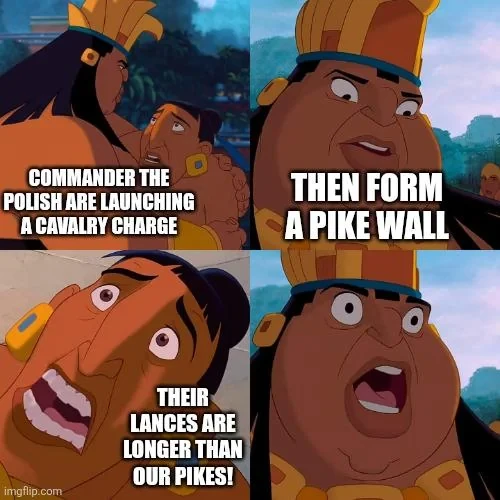
Explanation: For a brief period of time in the late 16th and 17th century AD, there was a curious ‘arms race’ in Eastern Europe. Normally, pikemen fend off cavalry by, in no small part, having a longer weapon than the cavalrymen have. Typically, a pike will be over 3 meters, while a cavalry lance rarely exceeds 2.5 meters. The feared cavalry of the Polish Winged Hussars, to counter pikemen, starting having longer lances made… which caused pikemen to respond with longer pikes… which caused the Winged Hussars to adopt longer lances… which caused… well, you get the picture.
One of the major innovations, or why no one tried this before, was that the Poles had invented a new kind of cavalry lance - the kopia, which was hollow along the shaft (greatly reducing weight). As it was considered that, for shock cavalry, a broken lance was a sign of a good charge anyway, the reduced durability of the lance was an acceptable tradeoff for finally being able to show those damn pikemen what-for! The kopia was also more expensive than an ‘ordinary’ lance, but as the Winged Hussars were an elite unit, they could afford it - including the practice of keeping assistants in reserve during the battle with numerous spare kopia so the Winged Hussars could charge time and time again!
Eventually, this arms race was put to an end by the supremacy of firearms, which would replace pikes in infantry formations entirely.
I was definitely curious about that. If your lance was broken by a shield though, was it really effective? A hollow lance would be more easily fended off, so the shield could be lighter as well…
At this time, shields had been largely abandoned, since pikes require two free hands to handle effectively.
The thinking behind a broken lance being effective is less about the durability of the lance itself, and more that it signals that the charge had real force behind it. With the invention of the stirrup and the technique of couching one’s lance (tucking it under the arm to brace it against the body - which is anchored to the horse by the stirrups) immense force was imparted from the lance to the target. A good percentage of the concentrated momentum of horse and rider was channeled into a single spear-point, making it about as deadly as any strike could possibly be.
But more than that, the lance itself was disruptive when delivered by a forceful charge - the lance is long enough that it comes before the the horse and rider. If you’re hit by a weapon that’s being imparted with enough force to snap, unless that’s some shitty wood, you’ve been hit pretty hard - certainly hard enough to lose your footing, even if you took it on your armor or a shield. And footing is the difference between slowing a charging cavalryman with your mass, and being unremarkable terrain under his horse’s hooves…
So if your lance breaks, that meant, to medieval knights and some early modern cavalry, that the charge was good. A broken lance meant you got a nice square hit, put all your momentum into the weapon that presaged the bodily clash, and did as much as anyone could hope to with the weapon - after all, if your strike is so firm that it breaks your lance, the only way you could have gotten more out of it would be by a stronger lance! You’ve ‘maxed out’ on personal effort!
In addition, lances were often discarded after the initial charge anyway, as they’re unwieldy in hand-to-hand combat, so your lance snapping on the charge or being trampled to pieces during the melee isn’t really a difference, speaking in terms of materials/finances.
Huh, I didn’t know that. I just
REMEMBER
Apart from the time frame. What does it have to do with the failed plot of some Catholics in England?