

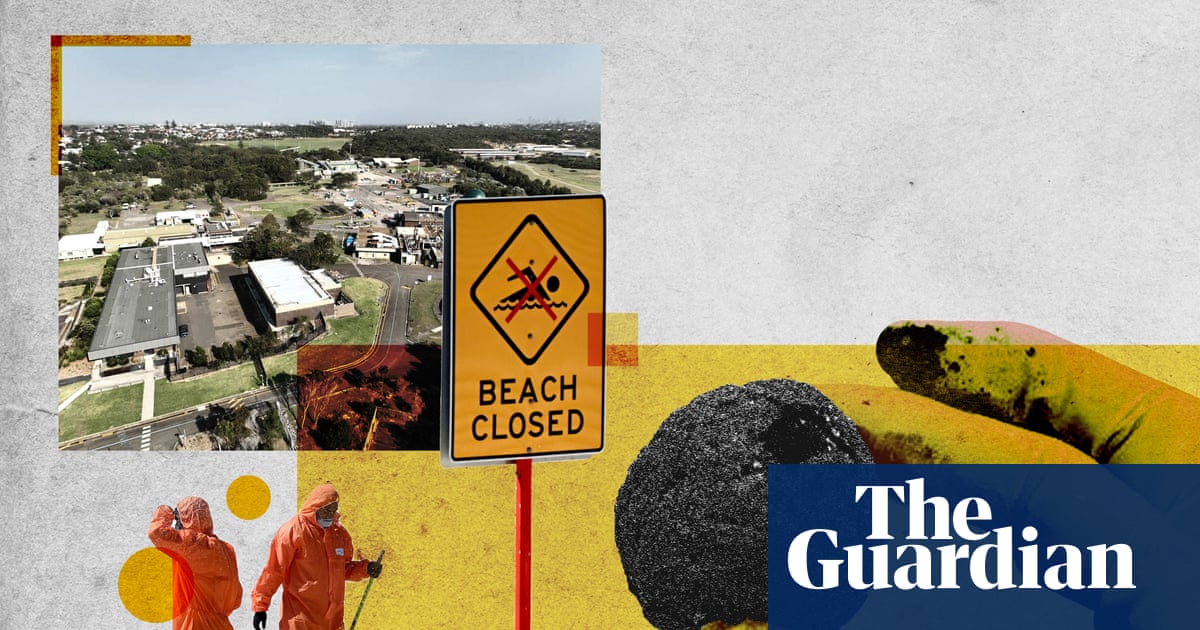
A giant fatberg, potentially the size of four Sydney buses, within Sydney Water’s Malabar deepwater ocean sewer has been identified as the likely source of the debris balls that washed up on Sydney beaches a year ago.
Sydney Water isn’t sure exactly how big the fatberg is because it can’t easily access where it has accumulated.
Fixing the problem would require shutting down the outfall – which reaches 2.3km offshore – for maintenance and diverting sewage to “cliff face discharge”, which would close Sydney’s beaches “for months”, a secret report obtained by Guardian Australia states.
“The working hypothesis is FOG [fats, oils and grease] accumulation in an inaccessible dead zone between the Malabar bulkhead door and the decline tunnel has potentially led to sloughing events, releasing debris balls,” the report concludes.
“This chamber was not designed for routine maintenance and can only be accessed by taking the DOOF offline and diverting effluent to the cliff face for an extended period (months), which would close Sydney beaches.”
A modern western city that dumps fucking raw sewage directly into the ocean. Embarrassing.
Yeah. We are an arrogant, fucked up species.
This is highly misleading. Even if you can get drinking water out of sewage, most of it is disposed somewhere. Sidney might be doing a shit (pun intended) process, but there’s no magic way too turn it all into water.
Vienna, too, is known for its pure waste water. The output into the Danube river is tap water quality.
Citation needed.
I highly doubt that. There would be absolutely no reason to clean the water up to tap water quality and then discharge it into the river, instead of using it as tap water. That’s just not economically feasible.
I know a part of the Danube near Vienna is a valuable nature reserve, but even then tap water quality is not necessary.
If you have a source that proves your claim, I’d be highly interested to learn why and how they do that. I have a degree in environmental engineering, and I want to know when I’m wrong about something like this.
Not my circus or my monkeys, but I can’t sleep so I did some cursory searching. I did undergrad research that was heavy into wastewater treatment, so this did sound a bit unlikely.
I found the biological secondary is pretty extensive and is being well utilized for energy generation, so the resultant level of treatment makes more sense. It looks like the claim is closer to “you could drink it if you wanted to, but don’t”.
https://envsci.ceu.edu/article/2025-02-27/turning-waste-power-visit-viennas-wastewater-treatment-plant
https://www.wte.de/en/references/wastewater-treatment-vienna-austria/
Nice that the article is trying to make it sound like such solutions are from ‘other countries’
Meanwhile, we have full treatment in South Australia and the outflow water is used for watering gardens.
As a fellow South Australian, I had the same thought. This is NOT an Australian issue, this is a Sydney issue.
‘Sydney is a hole’ is factually accurate.
I did a sewage treatment plant tour in my high school biology class. At the end of the second stage filtration, the worker pointed at how it discharges into the ocean.
“So at this point, the water has been treated enough that it’s safe to drink”
We all scrunched our faces at that. Then he added
“But I wouldn’t”
You really should not.
Waste water treatment, in order to reach human consumption grade, undergoes several stages of treatment.
Removes solids, largely unsoluble, be it organic or inorganic
Forced oxygenization, to activate micro organism capable of digesting the organic matter present. This stage is the most crucial for the entire process.
Waters are allowed to settle, in order to separate solids, now highly rich organic mud, from the water, in large pools or tanks, that are continually fed. Entering water displaces already clarified and mostly depleted of oxygen water, which can safely be returned to nature.
Previously clarified water undergoes UV treatment and/or has added minute quantities of sodium hypochlorite, for disinfection purposes. Microfiltering can be added subsequently.
This water is safe for use in street cleaning, irrigation, industrial uses, fire fighting, etc.
Obligatory microfiltering, followed by reverse osmosis process, to remove heavy metals and trace chemicals, followed by filtering through activated charcoal filters. Mineral (sand and rock) filters are then used to give back minerals to the water, to give it an organoleptic profile.
Stabilization of pH and final clarification can be done, before being reintroduced to the supply network.
The whole world should be doing it this way simply because if fresh water sources are being used for potable water, it’s likely that same source is being used to to discard the so-called treated sewage water … which is then taken up and distributed as potable water (with disenfectants added).
Thing is if you don’t use the reverse osmosis stage your community is drinking water that is contaminated with every drug (legal and illegal) that people have peed out.
Studies have shown fish in the Great Lakes - which are used both for returned treated sewage and drinking water - are being affected by some of those drugs (especially the ones that affect hormones).
Hells Bells, I knew. Hells Belle… Glad to meet you.
The issue with sanitation is that it consumes resources, and a good amount of if, in a very short time. And planning and putting it down requires specialized, skilled, work, which costs a lot of money. And maintain and operate it returns a permanent cost.
Politians are not willing to do this and are mostly uncapable of explaining why this should be done. It also does not help most people being completely ignorant or uncaring for ecological impact, unless it comes back to bite their behind.
Waste water management is crucial and it is a source of resources, water only being the first.
Muds can be harvested for digestion, in order to produce methane for generating electricity. Depending on the scale, it can be used to power the plant alone or to inject into the wide power grid.
Digested muds can be further processed by composting and then be funneled towards agriculture and forestry.
Fats can be harvested, purified and transformed into soaps, creams and industrial lubricants. Extremely well purified fats can even be converted to fuel or even added to feeds.
Going green is necessary and extremely profitable.
If enough ambition is put in place, fully organic treatments can be put in place and wild life can be made part, by default, of treating waste waters and fish, water fowls and even plants with secondary uses can be introduced to create another value chain.
However, to kickstart all of this, it is necessary to make people aware that water, regardless carrying waste, is still water and, as such, is precious.
How do you know so much about waste water treatment and why are you so optimistic about what could be done?
I’ve got a relevant university degree, and I’m way less optimistic about most of these topics.
For example:
This is usually not a net gain. Wastewater treatment plans consume more energy than can be harvested from the wastewater. The only WWTP I know that claims to produce more than they require for operation can only do so, because they accept additional organic material from a nearby slaughterhouse into their sludge fermentation stage, which is a bit of a cheat.
The same plant is btw also burning their treated sludge because it contains too many pollutants to be used in agriculture.
I work in the field and some units can in fact produce enough gas to self sustain operation. It is about choosing the right process and the adequate machinery.
Newer systems, with SBRs, do tend to produce a lot less muds. Older systems, like the one I spend more time on, produces a great deal more of muds.
A midsize city around where I live is currently undergoing viability studies to implement a digestor. They are trucking off-site 30 metric tons of dehydrated muds for composting every two or three days. If the muds could be digested first, they could cut back a good deal on the energy bill.
Other places are installing solar panel arrays and considering batteries next.
You would be amazed how often “the solution to pollution is dilution”. Can’t dump that raw chemical into the water/sewer, oh no. But if you dilute it with 5000 gallons of water? Oh well now it’s at “acceptable levels”. Notice how most regulations talk about “parts per million”(PPM). Well, it turns out that when most of your regulations are written such that you only have to “properly dispose” of something if it’s above a certain concentration, you can just dilute it below that level and BAM, “safe to dispose of”.
Well, yes. Dumping high concentrations will instantly kill everything in the waterway, diluting them and doing it slowly means they can handle it and survived.
Heck, the ocean is full of salt, but if you started dumping high-concentrated brine off a beach you’d kill every animal and plant on sight, just as you would kill yourself drinking said brine. But it would be quite hard to argue that you can’t safely put salt in the ocean, or add some to your food, once it is diluted to a safe level.
The question is how much of something total can the ocean handle before it becomes a problem. And for many things the answer is, quite literally, that it is just a drop in the ocean.
“It’s outside the environment”
There’s nothing out there
all there is is sea, and birds, and fish…
…and 20000 tonnes of crude oil…
…and a fire
this is much more common than you think
I’m hoping it’s not RAW sewage
JPEG sewage
This compression is shit.
It is. Sydney only does “primary treatment” which is literally running it through a strainer to separate the big chunks, and then they just dump it.
I wouldn’t want it cooked as well