
https://en.wikipedia.org/wiki/Elizabeth_Van_Lew
Upon the outbreak of the war, Van Lew began working on behalf of the Union with her mother, caring for wounded soldiers.[5] When Libby Prison was opened in Richmond, Van Lew was allowed to bring food, clothing, writing paper, and other things to the Union soldiers imprisoned there. She aided prisoners in escape attempts, passing them information about safe houses and getting a Union sympathizer appointed to the prison staff.[6] Van Lew reportedly helped Union soldiers by giving them money to bribe Confederates.[7]
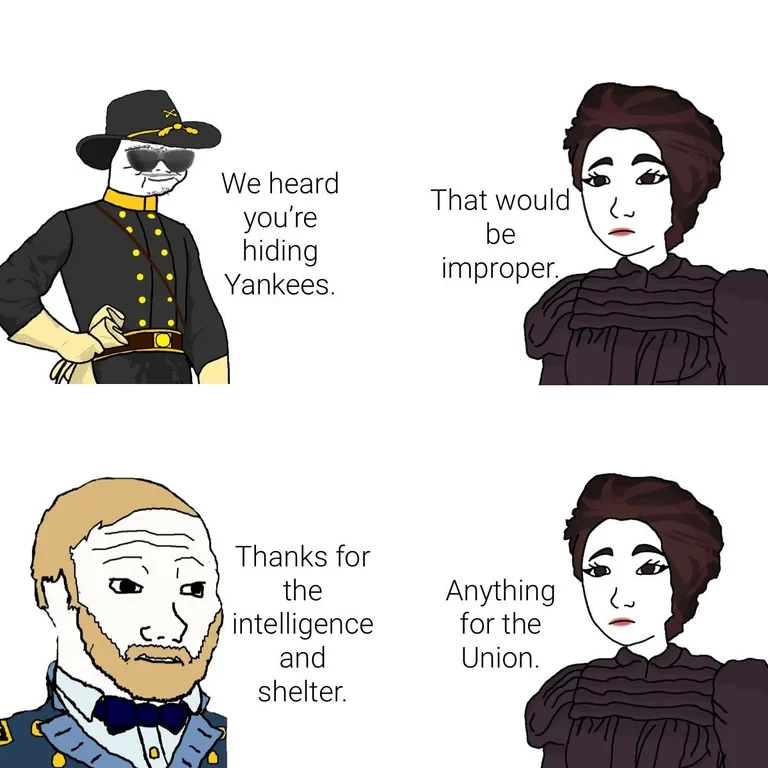
Recently captured prisoners gave Van Lew information on Confederate troop levels and movements, which she passed on to Union commanders.[5] She is rumored to have helped hide escaped Union prisoners and Confederate deserters in her own mansion, although no definite proof of such claims has been found.[8]
Van Lew’s spy network was so efficient that on several occasions she sent Lt. Gen. Ulysses S. Grant fresh flowers from her garden and a copy of the Richmond newspaper.[6] She developed a cipher system and often smuggled messages out of Richmond in hollow eggs.[6] Union commanders highly valued Van Lew’s work; intelligence commander George H. Sharpe, Army of the Potomac, recommended that the government reimburse Van Lew $15,000 because of the great expense she incurred in her efforts, including employment of spies.[1] Because of the merit of her work, General Grant appointed Van Lew Postmaster General of Richmond for the next eight years.[11][1]
When Richmond fell to U.S. forces in April 1865, Van Lew was the first person to raise the United States flag in the city.[8]
On Grant’s first visit to Richmond after the war, he had tea with Van Lew, and later appointed her postmaster of Richmond.[12] Van Lew modernized the city’s postal system and employed several African Americans, with the same pay and benefits as white employees, until new President Rutherford B. Hayes had her replaced in 1877.[13] She was allowed to return as a postal clerk in Richmond, where she served from 1883 to 1887.[2]
After Reconstruction, Van Lew became increasingly ostracized in Richmond. “No one will walk with us on the street,” she wrote, “no one will go with us anywhere; and it grows worse and worse as the years roll on.”[8] Having spent her family’s fortune on intelligence activities during the war, she tried in vain to be reimbursed by the federal government.[12] When attempts to secure a government pension also failed, she received support from the family and friends of Union Col. Paul Joseph Revere, whom she had helped while he was held prisoner during the Civil War. These Bostonians gladly collected money for the woman who helped so many Union soldiers during the war.[14][15] However, neighborhood children, including future novelist Ellen Glasgow, were told to consider her a witch.[2] Even into the twentieth century, many white Southerners regarded Van Lew as a traitor. However, among Richmonders of color and white Unionists, Van Lew was an honored figure.
Van Lew’s spy network was so efficient that on several occasions she sent Lt. Gen. Ulysses S. Grant fresh flowers from her garden and a copy of the Richmond newspaper.
What does this mean?
Btw you gotta put a > between the paragraphs too to make it all into one big quote:
>paragraph1
>
>paragraph2lmao, thanks, I remember fighting with it a bit after I moved from Lemmy, but I eventually got tired of it and just started letting them divide instead of risking it being on massive run-on.
What does this mean?
While deep in enemy territory, undetected and mostly unsuspected, she sent General Grant fresh flowers as little tokens of Richmond just as a way of saying “I’m here, and I’m invulnerable”
The local newspapers might also contain some intel, being notoriously loose-lipped institutions.
Certified More Than A Hero.