Curious that they put the full force of their party running in the Constituent Assembly, only to declare it illegitimate when it became apparent that they didn’t have a working majority. Almost like they decided that the assembly was illegitimate only it was clear the people hadn’t spoken FOR them.
Well, at least they gave power to the Soviets after that, right?
… right?
… massacred dissidents, you say? For demanding “All power to the Soviets”, the Bolshevik motto in 1917? Hm.
Also, the Soviets at this time period were open ballot and run by voice vote or show of hands, as counted by the Soviet’s chairman overseeing procedure, of course. Many Soviets elected their representatives with only a fraction of the electorate - turnout for the 1917 Constitutent Assembly election was ~60% - turnout in some Soviets, including prominent Soviets like in Petrograd, could be as low as 5%. And as each Soviet determined eligibility to vote independently, each such tiny portion of the voting ‘electorate’ was free to deny whomever they found too ‘bourgeois’ to vote, or be allowed to speak. No points for guessing whether the tightly organized party of dogmatic lunatics dominated in those circumstances.
The Bolsheviks genuinely became more popular as 1917 wore on (and then rapidly lost popularity in 1918, leading them to suspend elections even in the Soviets); but that’s not the same as saying the system of Soviets was ‘just another’ democratic institution. It was a markedly less democratic institution than a national vote for a representative legislature, and a national vote for a representative legislature is not exactly peak democracy.
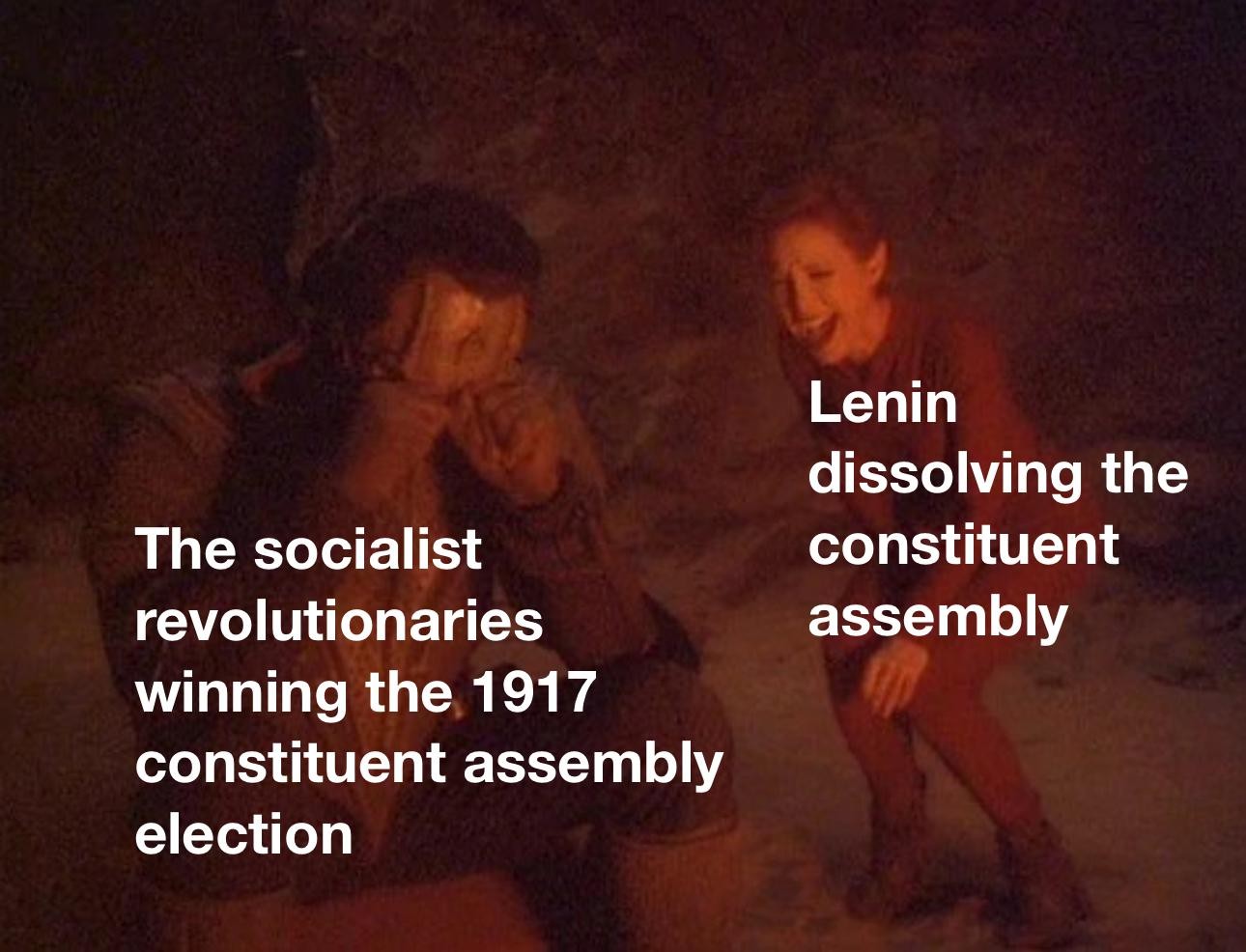
Curious that they put the full force of their party running in the Constituent Assembly, only to declare it illegitimate when it became apparent that they didn’t have a working majority. Almost like they decided that the assembly was illegitimate only it was clear the people hadn’t spoken FOR them.
Well, at least they gave power to the Soviets after that, right?
… right?
… massacred dissidents, you say? For demanding “All power to the Soviets”, the Bolshevik motto in 1917? Hm.
Also, the Soviets at this time period were open ballot and run by voice vote or show of hands, as counted by the Soviet’s chairman overseeing procedure, of course. Many Soviets elected their representatives with only a fraction of the electorate - turnout for the 1917 Constitutent Assembly election was ~60% - turnout in some Soviets, including prominent Soviets like in Petrograd, could be as low as 5%. And as each Soviet determined eligibility to vote independently, each such tiny portion of the voting ‘electorate’ was free to deny whomever they found too ‘bourgeois’ to vote, or be allowed to speak. No points for guessing whether the tightly organized party of dogmatic lunatics dominated in those circumstances.
The Bolsheviks genuinely became more popular as 1917 wore on (and then rapidly lost popularity in 1918, leading them to suspend elections even in the Soviets); but that’s not the same as saying the system of Soviets was ‘just another’ democratic institution. It was a markedly less democratic institution than a national vote for a representative legislature, and a national vote for a representative legislature is not exactly peak democracy.