Explanation: Herodotus was an ancient Greek writer who is often known as the “Father of History”, due to his works being the foundation for Western study of history from that point forward - attempting to meaningfully connect cause and effect, likelihood of events, sources, etc; rather than just chronicles of what happened in one region of one country, or blatant mythmaking with no foundation in fact.
… however, Herodotus is also sometimes known as the “Father of Lies”, because while his is the first major attempt at sorting all those issues out and forging them into a coherent narrative, he is… lacking established tools of the discipline, shall we say? His judgements as to what is and is not credible do not always pass the modern sniff-test - especially since his access to foreign sources and foreign lands would have been very limited at that time! So invariably, he passes along a few tall tales, especially about distant lands like India.
In Herodotus’s defense, he admits that he is only relaying what travelers have told him about the far and exotic land of India, and, while unstated, the story probably went through translation several times before finding its way to him, lmao.
If myths are born of trying to explain events with limited data, l wonder if he hadn’t been doing the same, perhaps unaware of the fact, but now on a broader scale.
Expanding on this thought, I guess myth, philosophy and scientific method would be parts of a same spectrum?
Expanding on this thought, I guess myth, philosophy and scientific method would be parts of a same spectrum?
In line with this, many ancient thinkers believed that myths - some even saying the stories of the gods - expressed mundane truths simply distorted by time and transmission. Also in line with that, ‘natural philosophy’ is an older term covering the fields we’d now regard as ‘science’, because it was seen as simply an attempt to discover the inner reasoning of the natural world, the same way philosophers attempted to discover the inner reasoning of the metaphysical world.

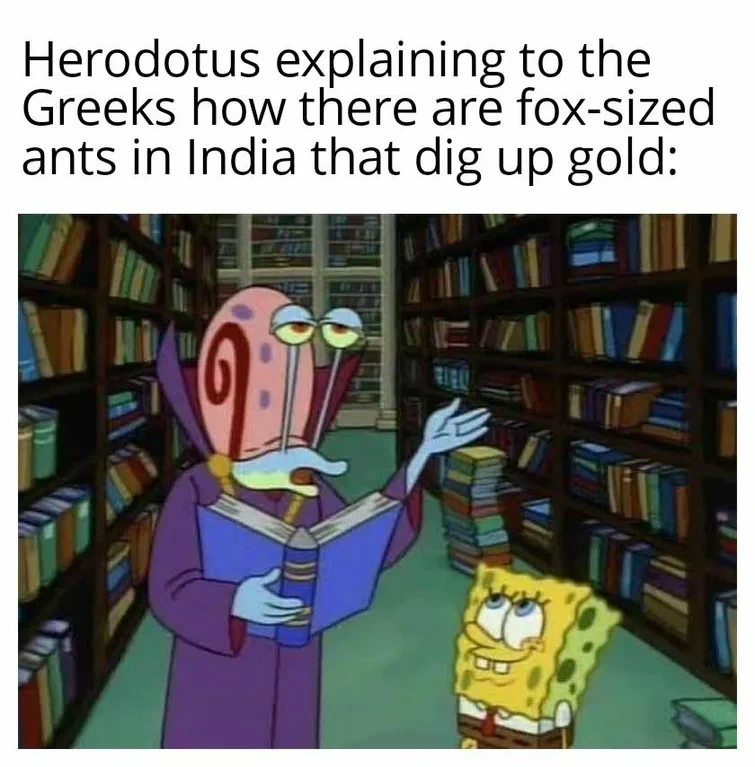
Explanation: Herodotus was an ancient Greek writer who is often known as the “Father of History”, due to his works being the foundation for Western study of history from that point forward - attempting to meaningfully connect cause and effect, likelihood of events, sources, etc; rather than just chronicles of what happened in one region of one country, or blatant mythmaking with no foundation in fact.
… however, Herodotus is also sometimes known as the “Father of Lies”, because while his is the first major attempt at sorting all those issues out and forging them into a coherent narrative, he is… lacking established tools of the discipline, shall we say? His judgements as to what is and is not credible do not always pass the modern sniff-test - especially since his access to foreign sources and foreign lands would have been very limited at that time! So invariably, he passes along a few tall tales, especially about distant lands like India.
In Herodotus’s defense, he admits that he is only relaying what travelers have told him about the far and exotic land of India, and, while unstated, the story probably went through translation several times before finding its way to him, lmao.
“So they have these giant elephants that carry the gold from the mine”
Herodotus half listening: “Giant ants?”
If myths are born of trying to explain events with limited data, l wonder if he hadn’t been doing the same, perhaps unaware of the fact, but now on a broader scale.
Expanding on this thought, I guess myth, philosophy and scientific method would be parts of a same spectrum?
…or he just liked lying from time to time. :v
In line with this, many ancient thinkers believed that myths - some even saying the stories of the gods - expressed mundane truths simply distorted by time and transmission. Also in line with that, ‘natural philosophy’ is an older term covering the fields we’d now regard as ‘science’, because it was seen as simply an attempt to discover the inner reasoning of the natural world, the same way philosophers attempted to discover the inner reasoning of the metaphysical world.