The University of Oxford was founded in 1096 as a Catholic university with a curriculum in theology and canon law. The University of Cambridge was founded in 1209 by people from the University of Oxford, so also largely clergy. The University of Salamanca was founded in Spain in 1218, also to teach theology and canon law (and, in fairness, some harder sciences as well). The first subjects to be taught at the University of Padua when it was founded in 1222 were law (civil law and canon law) and theology.
And while it’s true that the University of al-Qarawiyyin was founded as a mosque, mosques in that time were well-known and attested as places of learning; there’s evidence that al-Qarawiyyin was a madrasa from the very beginning (and proof of it by the 12th Century at the latest), and while people in European universities try to draw a distinction between the definition of “university” and “madrasa,” there’s no real evidence for a meaningful difference that doesn’t just boil down to “well, they do stuff differently.”
Yes, mosques were major centers of learning, and yes, madrasas were formal institutions of higher scholarship. No serious historian denies that. The question isn’t whether they were sophisticated or prestigious. They clearly were.
The debate is whether the madrasa model functioned as a corporate juridical body in the same way the medieval European universitas did.
Madrasas generally operated through:
Endowments (waqf)
Individual scholars granting ijazahs (licenses to teach specific texts)
Study circles tied to particular teachers
Administrative oversight embedded in religious or political authority
What they typically did not have was:
A single incorporated body of masters and students with collective legal standing
A standardized multi-faculty structure under one corporate identity
Degree hierarchies equivalent to bachelor/master/doctor conferred by the institution itself rather than by individual scholars
That distinction is structural, not civilizational.
Saying “they do stuff differently” understates the difference. The difference is not about religion or content. It’s about legal personality and corporate organization.
You can absolutely argue that the European definition is too narrow or too culturally specific. That’s a fair historiographical critique. But saying there’s “no meaningful difference” isn’t accurate — there are documented differences in governance, legal status, and credentialing models.
So the real disagreement is this:
Do we define “university” broadly as any enduring institution of advanced learning that granted recognized credentials?
Or do we use the term in its specific medieval legal-institutional sense?
If you choose the broader definition, then al-Qarawiyyin clearly qualifies very early.
If you choose the narrower juridical definition, then historians debate whether the madrasa structure fits that category prior to modern reforms.
In short, it’s not a university. And that’s okay. Trying to pigeonhole it into that definition is the issue.
If you choose the broader definition, then al-Qarawiyyin clearly qualifies very early. If you choose the narrower juridical definition, then historians debate whether the madrasa structure fits that category prior to modern reforms.
In short, it’s not a university. And that’s okay. Trying to pigeonhole it into that definition is the issue.
“If it’s the broader definition, it’s a university. If it’s the narrow definition, it’s debatable. In short, it’s not a university.”
No you don’t see it. It’s not a university. And if we open up the definition then you’re still wrong because Chinese institutions like the Guozijian and Yuelu Academy are older in origins and represent sophisticated, long-running centers of advanced learning.
No you don’t see it. It’s not a university. And if we open up the definition
Of the two definitions you gave in that comment for a university, one you admitted al-Qarawiyyin clearly was a university under; and the other you concede that it is debatable.
then you’re still wrong because Chinese institutions like the Guozijian and Yuelu Academy are older in origins and represent sophisticated, long-running centers of advanced learning.
You didn’t say “It’s not the oldest university”, you said
You didn’t say “It’s not the oldest university”.
That’s right. The post you posted said that. But it’s not even a university until 1963. If you broaden the definition the post is still wrong because Chinese institutions would be the oldest.
Your inability to accept that is the issue. If it was a university before, why would it reform to become classified as one if it already was one? That’s right, it wouldn’t need to because it would have been considered one already.
Your inability to accept that is the issue. If it was a university before, why would it reform to become classified as one if it already was one? That’s right, it wouldn’t need to because it would have been considered one already.
Yes, mosques were major centers of learning, and yes, madrasas were formal institutions of higher scholarship. No serious historian denies that. The question isn’t whether they were sophisticated or prestigious. They clearly were.
So, universities.
Madrasas generally operated through:
Endowments (waqf)
Individual scholars granting ijazahs (licenses to teach specific texts)
Study circles tied to particular teachers
Administrative oversight embedded in religious or political authority
Buddy. You just described Oxford, at least for the first couple hundred years. It’s not 1:1, but it’s very similar.
A single incorporated body of masters and students with collective legal standing
A standardized multi-faculty structure under one corporate identity
Degree hierarchies equivalent to bachelor/master/doctor conferred by the institution itself rather than by individual scholars
Oxford is to this day made up of 43 independent colleges that operate independently, which began as individual teachers teaching their subject. Incidentally, four of those are still today owned by religious institutions.
Do we define “university” broadly as any enduring institution of advanced learning that granted recognized credentials?
Or do we use the term in its specific medieval legal-institutional sense?
I feel like you intended this as a “gotcha,” but that’s literally what I mean by “no meaningful difference.” Especially back in the first millennium.
If you choose the broader definition, then al-Qarawiyyin clearly qualifies very early.
If you choose the narrower juridical definition, then historians debate whether the madrasa structure fits that category prior to modern reforms.
Then you probably have to exclude every university prior to modern reforms. It’s really not worth trying to split hairs for most schools.
In short, it’s not a university. And that’s okay. Trying to pigeonhole it into that definition is the issue.
Yeah, you really thought I was going to agree with you on the obvious answer there, but it really seems obvious to me in the opposite direction.
You’re welcome to assume I’m just dumb if it makes you feel better about being wrong, but saying “just read what I wrote” when someone clearly read what you wrote is essentially just admitting you have nothing else to add but would still like to pretend that you won the argument.
To wit: if you really thought I was wrong, you’d tell me specifically how.
I’m assuming you’re dumb because I’ve made you waste all this time responding. I was never trying to do anything except waste your time. Mission accomplished.
Nice. I was having a good time learning, writing, and explaining stuff, so I don’t feel like my time was wasted at all. So we both got what we want. Even though your goal was… really weird.


The University of Oxford was founded in 1096 as a Catholic university with a curriculum in theology and canon law. The University of Cambridge was founded in 1209 by people from the University of Oxford, so also largely clergy. The University of Salamanca was founded in Spain in 1218, also to teach theology and canon law (and, in fairness, some harder sciences as well). The first subjects to be taught at the University of Padua when it was founded in 1222 were law (civil law and canon law) and theology.
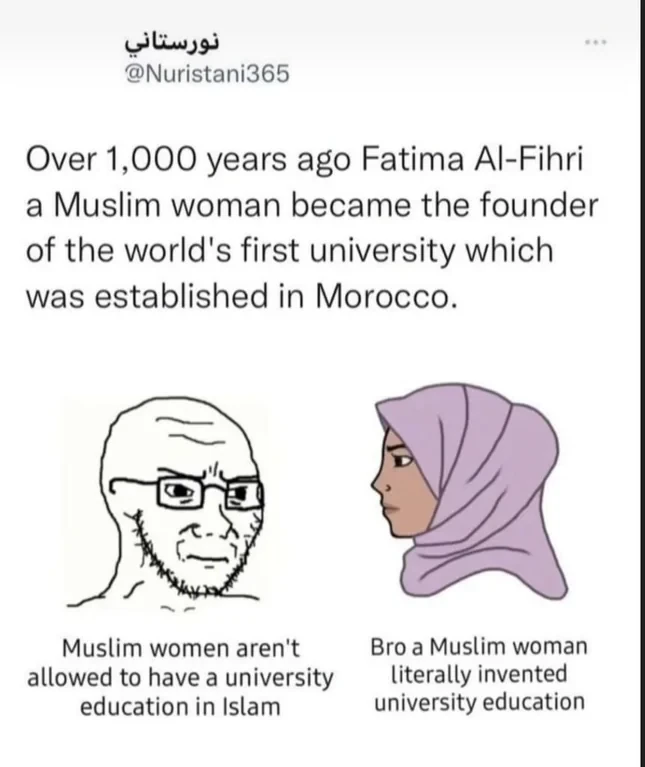
And while it’s true that the University of al-Qarawiyyin was founded as a mosque, mosques in that time were well-known and attested as places of learning; there’s evidence that al-Qarawiyyin was a madrasa from the very beginning (and proof of it by the 12th Century at the latest), and while people in European universities try to draw a distinction between the definition of “university” and “madrasa,” there’s no real evidence for a meaningful difference that doesn’t just boil down to “well, they do stuff differently.”
Yes, mosques were major centers of learning, and yes, madrasas were formal institutions of higher scholarship. No serious historian denies that. The question isn’t whether they were sophisticated or prestigious. They clearly were.
The debate is whether the madrasa model functioned as a corporate juridical body in the same way the medieval European universitas did.
Madrasas generally operated through:
Endowments (waqf) Individual scholars granting ijazahs (licenses to teach specific texts) Study circles tied to particular teachers Administrative oversight embedded in religious or political authority
What they typically did not have was:
A single incorporated body of masters and students with collective legal standing A standardized multi-faculty structure under one corporate identity Degree hierarchies equivalent to bachelor/master/doctor conferred by the institution itself rather than by individual scholars
That distinction is structural, not civilizational.
Saying “they do stuff differently” understates the difference. The difference is not about religion or content. It’s about legal personality and corporate organization.
You can absolutely argue that the European definition is too narrow or too culturally specific. That’s a fair historiographical critique. But saying there’s “no meaningful difference” isn’t accurate — there are documented differences in governance, legal status, and credentialing models.
So the real disagreement is this:
Do we define “university” broadly as any enduring institution of advanced learning that granted recognized credentials?
Or do we use the term in its specific medieval legal-institutional sense?
If you choose the broader definition, then al-Qarawiyyin clearly qualifies very early. If you choose the narrower juridical definition, then historians debate whether the madrasa structure fits that category prior to modern reforms.
In short, it’s not a university. And that’s okay. Trying to pigeonhole it into that definition is the issue.
“If it’s the broader definition, it’s a university. If it’s the narrow definition, it’s debatable. In short, it’s not a university.”
You legitimately don’t see it, do you.
No you don’t see it. It’s not a university. And if we open up the definition then you’re still wrong because Chinese institutions like the Guozijian and Yuelu Academy are older in origins and represent sophisticated, long-running centers of advanced learning.
Of the two definitions you gave in that comment for a university, one you admitted al-Qarawiyyin clearly was a university under; and the other you concede that it is debatable.
You didn’t say “It’s not the oldest university”, you said
You didn’t say “It’s not the oldest university”.
That’s right. The post you posted said that. But it’s not even a university until 1963. If you broaden the definition the post is still wrong because Chinese institutions would be the oldest.
…
Your inability to accept that is the issue. If it was a university before, why would it reform to become classified as one if it already was one? That’s right, it wouldn’t need to because it would have been considered one already.
…
So, universities.
Buddy. You just described Oxford, at least for the first couple hundred years. It’s not 1:1, but it’s very similar.
Oxford is to this day made up of 43 independent colleges that operate independently, which began as individual teachers teaching their subject. Incidentally, four of those are still today owned by religious institutions.
I feel like you intended this as a “gotcha,” but that’s literally what I mean by “no meaningful difference.” Especially back in the first millennium.
Then you probably have to exclude every university prior to modern reforms. It’s really not worth trying to split hairs for most schools.
Yeah, you really thought I was going to agree with you on the obvious answer there, but it really seems obvious to me in the opposite direction.
Read what I wrote. Read it again. Waste more of your time not getting it.
You’re welcome to assume I’m just dumb if it makes you feel better about being wrong, but saying “just read what I wrote” when someone clearly read what you wrote is essentially just admitting you have nothing else to add but would still like to pretend that you won the argument.
To wit: if you really thought I was wrong, you’d tell me specifically how.
I’m assuming you’re dumb because I’ve made you waste all this time responding. I was never trying to do anything except waste your time. Mission accomplished.
Nice. I was having a good time learning, writing, and explaining stuff, so I don’t feel like my time was wasted at all. So we both got what we want. Even though your goal was… really weird.