

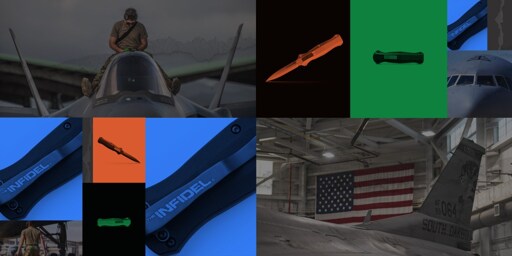
They call them “box cutters,” but everyone on the flightline knows what the term really means. The blades slide out at the push of a button, revealing high-end knives made and marketed for active combat. They cost the federal government hundreds of dollars each — and come free to maintenance workers in the Air Force who order them through the supply system and hand them out as favors.
For nearly a decade, Air Force maintenance units spent more than $1.79 million in taxpayer funds buying 5,166 high-end knives and other luxury items, including switchblades and combat-style tactical knives with no legitimate maintenance use, The Intercept has found. It’s a drop in the bucket of a U.S. military budget creeping ever closer to a trillion dollars, about $300 billion of which belongs to the Air Force. But with a military budget so bloated, the knife-ordering frenzy illustrates how obviously frivolous spending can go unchecked.
“Everyone knew we didn’t need them,” said a former noncommissioned officer recently honorably discharged from Hill Air Force Base. “There was literally zero justification in any maintenance field.”
“Corruption” that entertains junior enlisted should be viewed with a much less harsh eye than, for example, corruption that enriches senior officers, or contractors, or elected officials.
It’s not a good thing, but it’s not exactly what I’d call “important.” Plus, I’d be willing to bet it’s an artefact of the stupid budgeting system we use.
And honestly, a couple hundred dollars for a good knife (I’m assuming it’s at least better than Walmart knives, with “government tax” added) is pretty typical if you know your knives. Having a good knife if you use it often is so much better than a box cutter.
Edit: I did the math from the info in article. It’s $350 per knife. That’s honestly pretty low considering how much “government tax” is usually added.
$350 for a knife is lower mid-range, not what I would consider a luxury
Our ideas of luxury costs are significantly misaligned. I made do with a cheap $25 multi-tool until I got a skeletool for a Christmas present. Why other way is considered out of reach for me.
For pocket knives the scale is sort of divided like Production -> Midtech -> Custom. Even some production knives are pushing $500 (or more) now
I don’t doubt that. I also don’t want to deny a service member a knife. I carry one and think it’s pretty fucking handy.
My first point is that a serviceable utilitarian fixed-blade knife is in the $30-$50 range. With the service-member markup that is not anywhere near $300.
My second point is that buying a tool is about meeting the utilitarian need first. Maybe an entry level knife might not hold up as well as a mid-range of the same design, but as the price goes up, you are getting diminishing returns on utility. It might be off an assembly line, but anything over $50 is still a luxury.
Yeah … but if all you’re using it for is opening boxes, you don’t need a $350 mid-tier knife … you need a $15 box cutter with replaceable $0.50 blades.
If you want a fancy knife, sure – go get one … with your own money. But if you’re using taxpayer money for it, you can have the $15 box cutter that gets the job done just fine.
I was an enlisted aircraft maintainer for a term of service, and I don’t recall ever being in need of aa box cutter.
My opinion stands, however. They want knives, let them have knives.
Yes, they literally can’t stop.
I was in Air Force maintenance for a while. And it’s because of ‘use it or lose it’ budgets.
Every fiscal year, if your department doesn’t spend all of its allotted budget, then their budget will be reduced next fiscal year. Personal equipment, replacement parts, materials, etc all come from the same budget.
But how much money your department actually needs may vary from year to year. Maybe in a good year not much breaks and you don’t spend much on replacement parts. So you have surplus budget left over in the last month of the fiscal year:
A) You can do the right thing and submit your budget paperwork showing that you had some left over at the end of the year. Your budget will be reduced next year, which means if next year is a bad year that needs lots of replacement parts, you’re going to be running severely short.
B) You take the whole crew up to the Supply store and go on a shopping spree, buying up anything ‘nice to have’ that could even somewhat conceivably be relevant to doing your job. (Such as … a very fancy combat knife that you could conceivably use because you can use it to open boxes.) You use up the entire budget for the fiscal year, and next year your budget stays the same. So when next year is a bad year that needs lots of replacement parts, you still have enough money in your budget to buy all the parts you need.
This end-of-fiscal-year shopping spree is pervasive within not just the Air Force, but every government job where this ‘use it or lose it’ budgeting system is in place.
On the face of it, ‘use it or lose it’ is supposedly a way to help the military save money, by reducing the budgets of departments that are being allocated more money than they need. But it creates a perverse incentive for each department to ‘need’ all the money it has been allocated. The ‘use it or lose it’ budgeting system will have to be reformed significantly if this is to be fixed.
