
link to open access paper
https://journals.plos.org/plosone/article?id=10.1371%2Fjournal.pone.0338509
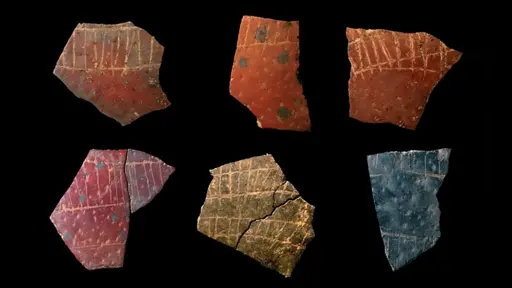
The results demonstrate that Homo sapiens during the late MSA mastered precise, pre-planned patterns anchored in specific geometric affordances: orthogonality and parallelism. These affordances were related and organized through a distinct set of cognitive operations: rotation, translation, iteration, and embedding.
Our dataset is particularly well represented by rotation, translation, and iteration, as these operations enable the construction of simple yet recurrent combinations, including aligned sets of lines and repeated angular configurations. Notably, the analysis revealed that some of these combinations generate a defined spatial framework within which embedding occurs. This framework represents a zero level—a reference plane—within which features and operations are nested to form highly structured, regularly spaced patterns such as hatched bands, grids, and diamonds.
What emerges is a ‘geometric grammar’, that is a coherent and procedural system of operations through which patterns are constructed according to a stable internal logic.

Fig 2. A synthesis of a spatial and chronological assessment of the EOES motifs. Data elaborated from Texier et al. [2]; Heshilwood et al. [3]; Jacobs et al. [29]. We have associated the two fragments from Apollo 11 to the ‘sub-parallel intersecting lines motif’ as, in our statistical analyses, they display the same values in terms of regularity of line alignments, consistent with the fragments in the same category from Diepkloof.
doi:10.1371/journal.pone.0338509.g002
I don’t like this headline. A human from 60,000 years ago would be anatomically identical to a modern human, brain included, so of course they mind would be able to produce sophisticated ideas. A better headline would have been about there are few examples of abstract mathematics from that long ago.
The Dawn of Everything makes this point fabulously and with loads of historical examples. The urge to look at the peoples of the past as primitive and lesser is a major fault in our understanding of ourselves and human societies
I’ve been reading it and I recommend it m mainly for this specific reason! Just because they were born long ago doesn’t make them stupid. And, thinking about it, maybe not having a massively time consuming and mind numbing job actually helped them develop their minds and thoughts.
And that calls into question the generally accepted notion that the way we’ve organized our societies has been getting progressively better over the timeline of our species and that we might be able to take some of the aspects of our modern world that meet that criteria(solar electricity, medical advancements, etc) can be applied to older paradigms. Fusing old and new to create a better world for human kind. Revolutionary book
Reminds me of Harari’s Sapiens, supporting the idea that most revolutions, starting from the agricultural one, actually made our lives globally worse.
I’ve got some criticisms of Harari but in general I agree. I think he leans a bit hard into the narrative of progression but i haven’t re-read Sapiens in the context of having read The Dawn of Everything
I also felt he was quite heavy handed on fitting his narrative, and 21 questions cemented that for me - not a book I would heavily recommend, it just fitted the topic
Sapiens is so heavily overfitted that I almost couldn’t finish it the first time I read it through. You could say the same about Dawn of Everything , except that Dawn 's purpose was to show that there were not just counterexamples for many generally accepted things, but in some cases new evidence that totally overturns some of that “common knowledge.”
For sure, I’m not gonna say the dude or the book has zero value, cause if memory serves there are some good points made. But overall I think he misses the mark hard because he wanted to hit a different one
One of my favorite books. Though I have to read it with 10 Wikipedia tabs opened.
Yeah that’s more than understandable, it’s dense as fuck, but well worth the effort!
I made my book club read it a couple of years ago. A few people did the audiobook. Even though I think it might be one of the most important and fascinating books of the last century, I cannot imagine the soporific power of that audiobook.
I look at humanity today and feel we’re quite primitive, worse than they were ages ago when they didn’t really have a choice.
Even in short timespans, I was downvoted harshly recently for disagreeing with somebody who said that the tech we use today was “unrealistic science fiction 50 years ago”.
Yeah I agree, I don’t like changing headlines but this one is pure science gore.
I like the article despite that however and the actual research paper is pretty cool.
Sacred geometry is millennia old.
[off topic?]
BRZRKR by Keanu Reeves and Matt Kindt. Immortal warrior fighting evil in the modern world.
At one point he’s talking to a scientist and says that it’s hard for him to remember everything that’s happened over thousands and thousands of years, but he remembers learning calculus a dozen times.
…please expatiate. Is this a graphic novel? XD
Silly me!
https://bookshop.org/beta-search?keywords=brzrkr&bkshp-astro=t
Bookshop.org is the ethical alternative to Amazon