

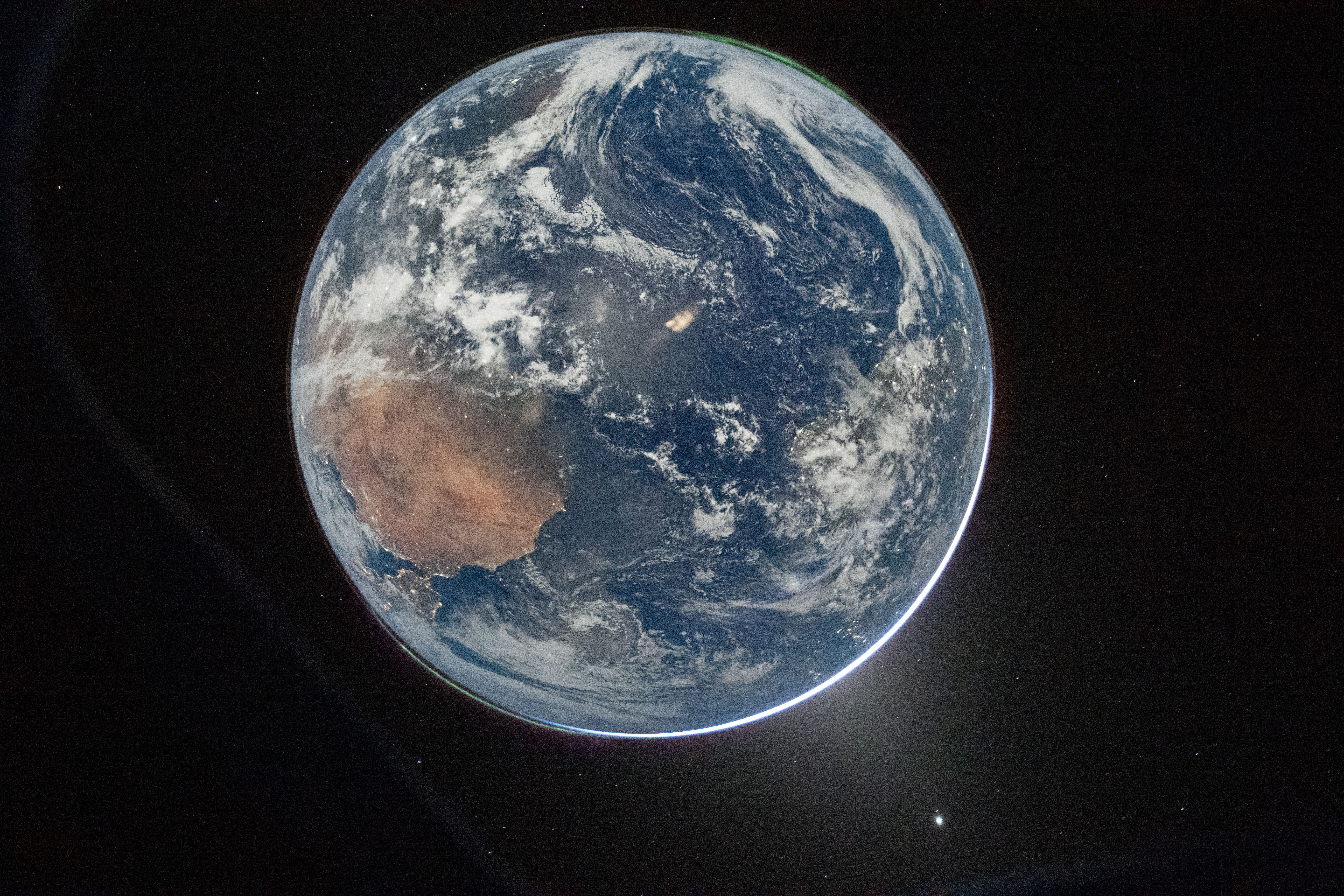
This image of home just came down from the Artemis II crew.
Taken after their translunar injection burn, there are aurorae at top right and lower left, and zodiacal light at lower right.
Credit: NASA/Reid Wiseman
// That’s home. That’s us.
-–
Alternative references of better image quality mentioned in comments by @baguette@piefed.social:
- https://images.nasa.gov/details/art002e000192;
- https://images-assets.nasa.gov/image/art002e000192/art002e000192~orig.jpg [5568 x 3712]
Wouldn’t a long exposure have less grain? Usually it’s short exposure and high ISO that results in grain.
Less grain than a shorter exposure? Absolutely. Due to motion you still have to cap exposure duration to a somewhat small number or you’ll start getting light streaking. It would be very interesting to see the exif information for this photo.
It is there:
Thanks! I should have looked.
ISO 51,200 is pretty high, which is why there’s the grain/noise. I wonder if whomever took the photo also tried with a somewhat longer shutter speed and/or wider aperture. Both would reduce ISO and thus noise but come with trade-offs. Longer shutter speed can result in light streaks due to motion and a wider aperture will give less depth of field.
it is the high iso that produces the visible grain.
long exposure time would have less grain, but to use it, you need for the scene to not move long enough.
the movement and subsequent blurred image is introduced by two different things. either the scene itself is moving, or it is the camera that is moving (your shaky hand, or the spaceship doing 20000+ km/h.
if the scene is not moving and you can use tripod to stabilize the camera movement, then you can use long exposure time and however low iso you want.
if this is impossible, because tripod in a spaceship would still not help shaking the camera relative to phographed object that is outside of the spaceship, then short exposure time (and high iso to compensate for that) is your only choice. (and still, even with the super high iso, it still was 1/4s. i suspect some stabilization in the lens.)
https://digital-photography.com/camera/aperture-exposure-time-iso-understanding.php
They’re in a moving spacecraft taking a shot of a rotating object. You can’t do too long of an exposure. It’s why astrophotographers either have to take lots of individual photos and stack them.