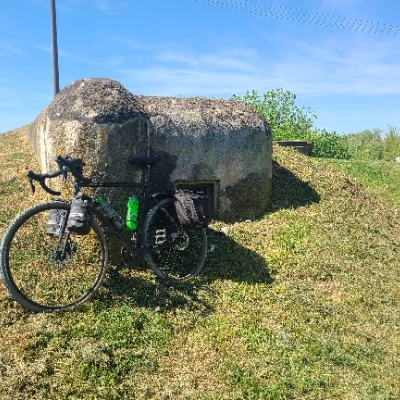

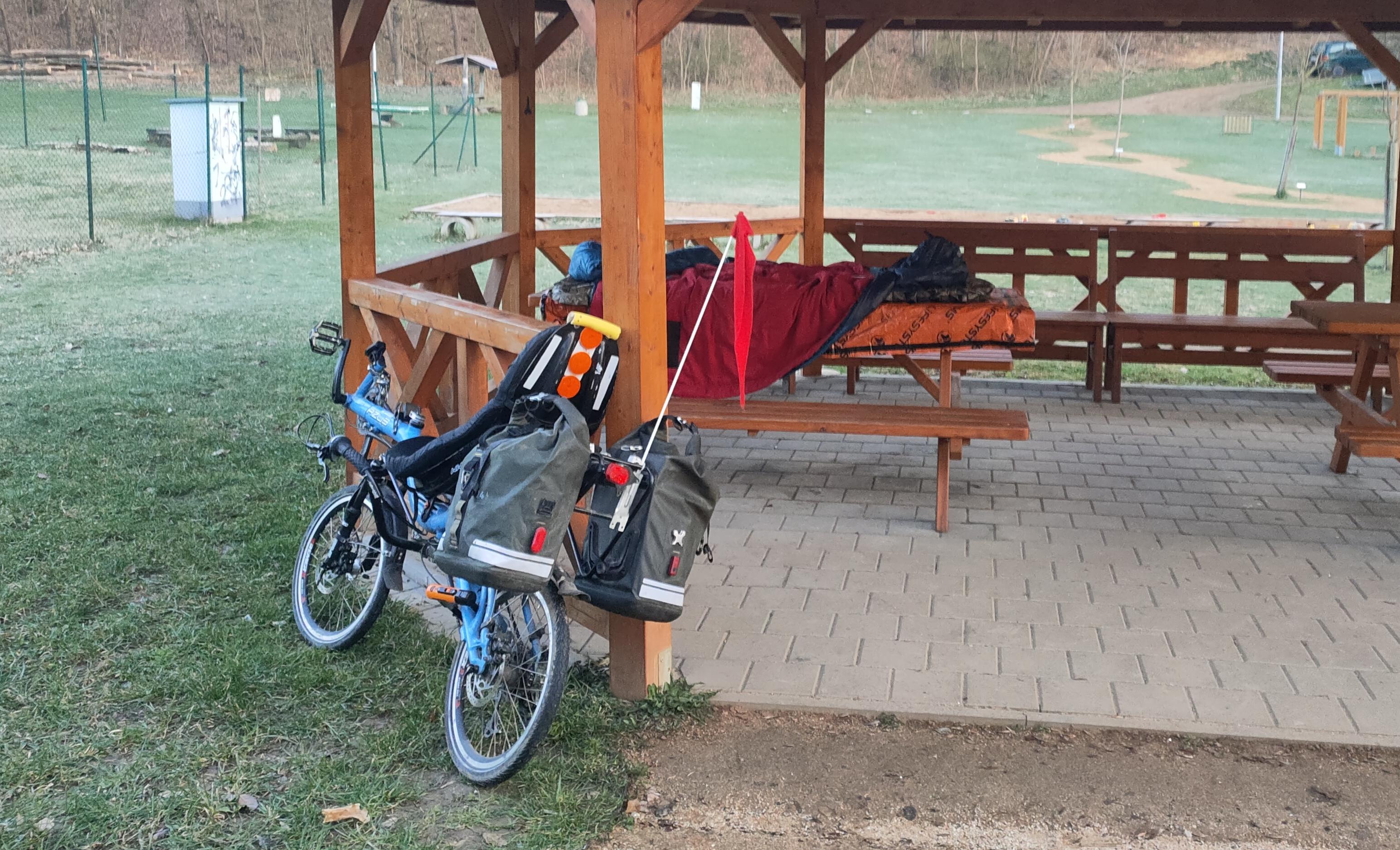
I have few thoughts about bikepacking on recumbent bike.
Because of the weight distribution I don’t see any difference in the ridability and handling. The issue with flexing bike when loaded with bags isn’t noticeable when riding only when you need to push it.
But the hills are killing me it isn’t ideal without the bags but with them it is brutal.
#bikepacking #biketouring #bikeTooter #regel17 @bicycle_touring
Your cited study concerns itself with power; your comment discusses force. The two are not the same. What your study is talking about is the equivalent of “horsepower”. What we have been discussing is the equivalent of “torque”.
FTFY. As soon as you consider a time component (“cadence”, or strokes-per-minute), you aren’t talking about force. You are talking about power.
A recumbent bike puts the rider in much the same position as the user of a leg press machine. An upright bike puts the rider in much the same position as the user of a scale.
You can only put force equal to your body weight on a scale. I’m betting that you can put force equal to several times your body weight on a leg press. Gravity does not assist the upright rider here: gravity limits the amount of force the upright rider can apply: any additional force doesn’t go into the pedal; it goes into lifting the rider off the seat. There is no question that the rider of the recumbent bike has the advantage on “force”.
Again, FTFY. Recumbents allow much greater force on the pedals, so your comment was patently false. De-conflating “force” from “power”, your comment starts to reflect the conclusions in your cited study. (Although the “MANY times” claim is still wildly misleading)
Upright bikes may be slightly more efficient at converting power, but the parent comment isn’t discussing power. They are discussing force.
You HAVE to be fucking trolling 😄
By your definition, the most/only effective method of riding a normal bicycle would be to simply jump up and down until you eventually reach your destination 😄
…do you have any idea how a bicycle chain or equivalent works? Have you ever SEEN someone operate a bicycle?
I don’t know if you’re joking, under the influence of powerful hallucinogenic substances, or a secret fourth thing, but you’re DEFINITELY not making sense regardless 😄
The reason I am “not making sense” is because you are continuing to not understand the distinction between “force” and “power”.
“Torque” is a measure of force. “Horsepower” is a measure of power. Do you understand the difference between the two? Until you understand that distinction, you will not be able to understand the discussion you have joined.
Yep! I’ve actually even ridden bicycles before! My hips have never been secured to an upright bike. Every time I’ve tried to press harder on the pedals than my body weight, my hips have come off the seat. The force my legs have applied to the pedals has lifted my body into the air, against the force of gravity. I’ve been able to introduce a little more force on the pedals, with my arms pulling my body downward toward the handlebars, but not by much.
On the recumbent bike, gravity and my arms aren’t what is providing the counter force to allow me to push against the pedals. The backrest of the bike is what I am pushing against. I can push far more than my body weight against the backrest. Much more than I can pull with my arms.
You’ve entered a discussion on “force”, but you are still failing to understand that you are talking about “power”. When you understand the difference between “force” and “power”, you’ll be able to understand the discussion. Until then, my commentary will not make any sense to you.
You’re completely forgetting the fact that you’re also pulling up with your “rear” foot as you’re pedalling. Moreover, pedalling is not “push down repeat on other leg”, but it’s a circular motion where you’re able to transfer power all through the cycle.
The maximum force you’re able to put to pedals is irrelevant, because so much of the power you output depends on the cadence. If you’re pushing your maximum force on the pedals, it already means you’ve lost the momentum and your power output is shit. The force has a small effect on sprints though.
Anyways, if the force was a major factor to prioritize, you’d see a lot more pro cyclists being swedish giants, but in reality most are on the shorter side. The benefits from lower weight and less drag from big body are far more important factors
See, I knew you could get there.
Now, I’m gonna have you go up to where the parent commentator discussed the importance of “force” and the use of arms on an upright bike, and reply your “power” comment to them, not me. I was directly rebutting their “force” arguments; I made no claims regarding “power” for you to rebut. Your criticism is wasted here. But, your insight would be valuable in the context of their argument.