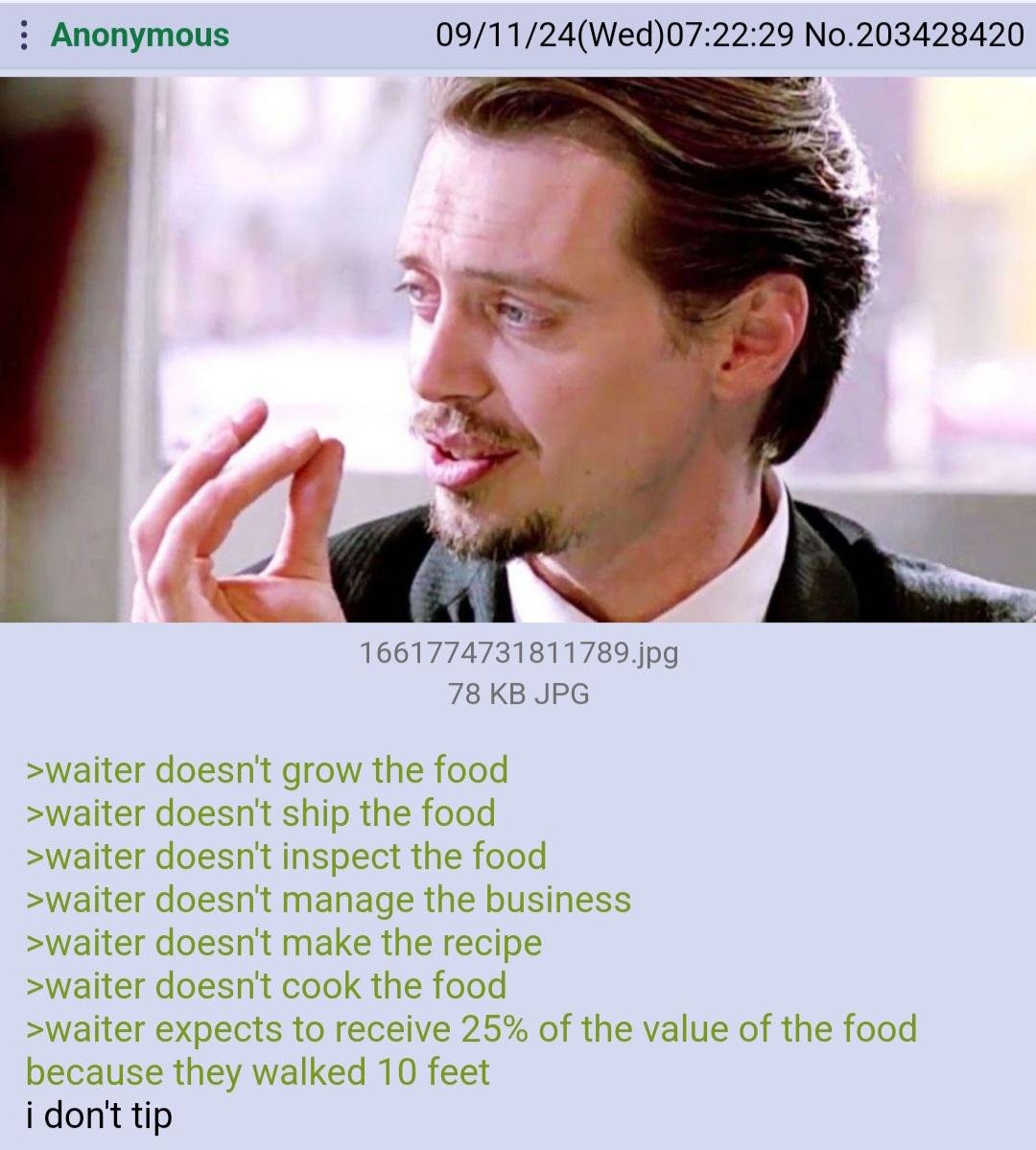

Replace waiter with “CEO” and you begin to understand why socialists believe what they do
Except instead of 25%, it’s 250%.
Who’s the cheap one in this equation?
… the customer who is paying the owner of the restaurant for the food AND is obligated by social convention to pay extra to the waiter who is underpaid.
or
… the restaurant owner who doesn’t mind living in a world where we have normalized underpaying restaurant workers to the point where we pass down that responsibility to the customer who is already paying for the food.
Pay your workers a proper wage and get rid of the idea of tipping.
If you live in a place where food service workers are underpaid and you don’t tip, you’re an asshole. This is not a morally defensible stance unless there is a system to protect those workers already in place.
deleted by creator
If you’re patronizing a restaurant that underpays wait staff and refuse to tip the server, you’re not only fucking them but you’re supporting the system by going to the restaurant in the first place.
deleted by creator
Sure, let me help you! My point is that if you’re patronizing a restaurant that underpays wait staff and refuse to tip the server, you’re not only fucking them but you’re supporting the system by going to the restaurant in the first place.
deleted by creator
How does withholding a tip end the current system?
deleted by creator
-
We don’t tip workers in those other fields you mentioned because they make a livable wage. Food service workers, particularly servers, often make less than minimum wage.
-
I’m glad wherever you live pays their wait staff a livable wage. If that happened in the US, tipping wouldn’t be the way it is now. Unfortunately the system has to change first. Until it does, if a customer patronizes a restaurant, they should tip. If someone can’t afford to tip, they should stay home.
-
The “invisible hand of the market” isn’t going to solve this issue. A change in labor law will. We either need state or federal laws to protect food service workers. Then employers will be forced to pay their staff better and tipping won’t be so compulsory.
deleted by creator
-